

You cleared the hard lot at dawn, the blade scraped clean, and the same machine is pointed at a drifted field entrance before lunch.
The tires that flew across asphalt now spin in loose snow, or the tracks that floated through the drift chew time on the next paved stop.
Skid steer tracks for snow only pay off when the surface and the snow depth call for them.
Decide tires or tracks first.
Then match tread and width to the storm you get.
Table of Contents
- When Tires Beat Tracks on Snow Jobs
- Matching Track Setup to Your Snow Conditions
- How Tread Pattern Controls Grip in Snow
- Why Track Width Changes Flotation and Push
- How Machine Setup and Attachments Change Track Demands
- How to Prepare and Run Tracks Through a Snow Event
- Confirm Track Specs and Warranty Before You Order
When Tires Beat Tracks on Snow Jobs
Say you run the same loader on two stops after every storm.
The first is a commercial lot: repeated passes on concrete, packed snow, and a thin ice film over asphalt.
The second is a field entrance buried in deep, loose snow.
One setup will not win both jobs.
Buying tracks only because winter is coming can slow you down on the hard surfaces where a lot of snow work happens.
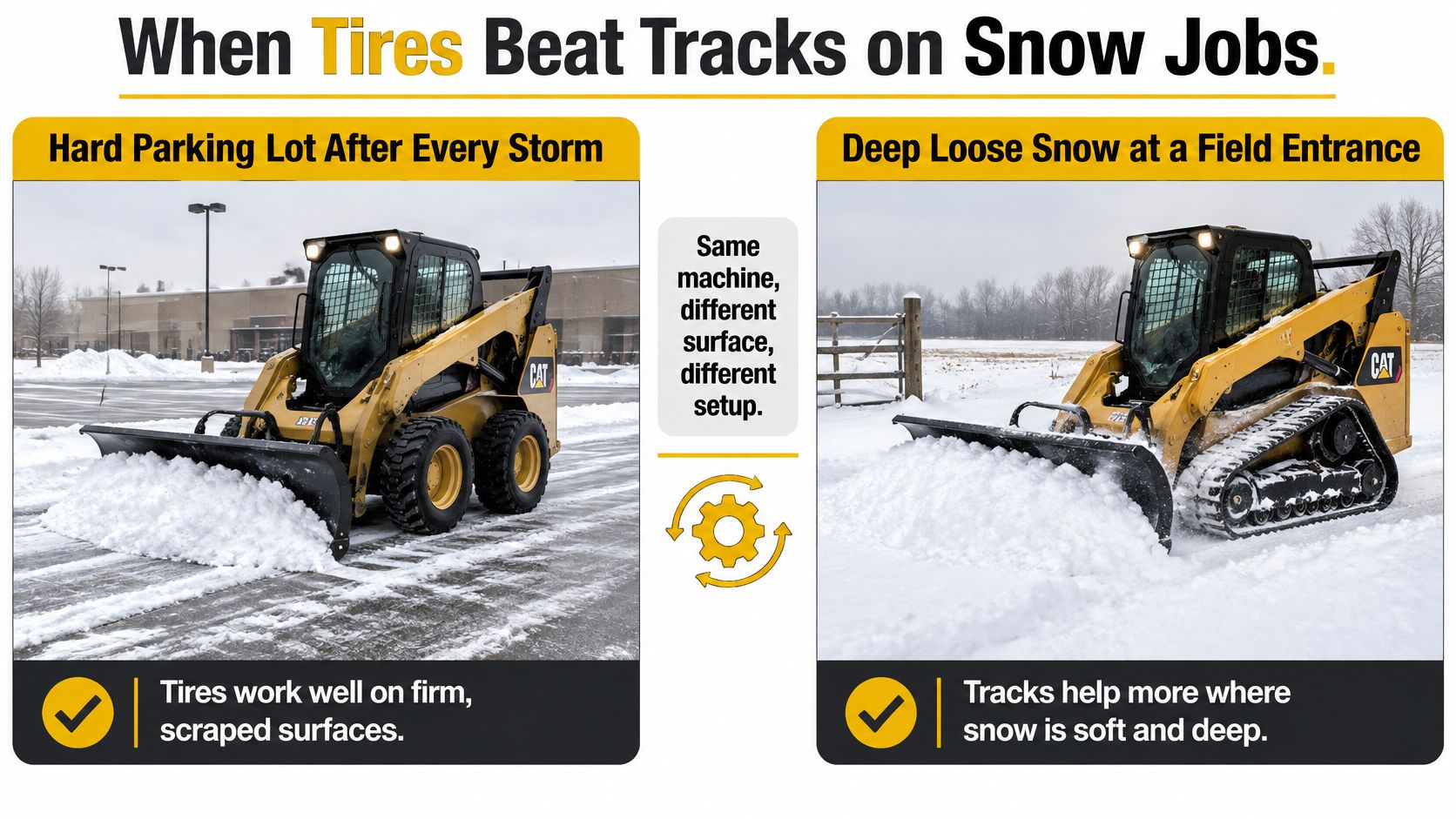
A 2025 skid steer buying guide from Compact Equipment notes that wheeled machines can outperform tracked machines on concrete, asphalt, and packed gravel because they travel faster, cost less to operate, and are easier to maneuver and transport.
The same comparison says wheels can break through packed snow and ice more effectively, while compact track loaders are favored on soft or rough ground. Track bite is not the same thing as ice traction.
On a scraped lot, downward pressure and speed matter more than flotation.
| Snow job | Tracks | Tires | Better choice |
|---|---|---|---|
| Repeated passes on bare asphalt or concrete | Slower travel, higher track wear | Faster travel, lower running cost | Tires |
| Packed snow and ice on a parking lot | Good push, limited bite on ice | Better break-through on packed snow and ice | Tires |
| Deep, loose, unconsolidated snow | Flotation prevents bogging | Can sink and lose traction | Tracks |
| Soft or rough ground under snow (fields, lawns) | Lower ground pressure, more contact points | Higher ground pressure | Tracks |
| Mixed property with hard and soft areas | Single setup for every surface | Seasonal swap or compromise | Tires when hard surface is most of the season |
Where the switch stops paying
Tracks mark pavement more readily and they add transport weight on the trailer.
A seasonal move to tracks, including over-the-tire tracks on a wheeled machine, makes sense only when soft ground or deep snow is a real share of the winter, not a one-off drift.
Practical rule: Add up the season before you buy. If most hours are repeated passes on firm lots, keep the tires. If most hours are deep or soft snow, put the tracks on.
Matching Track Setup to Your Snow Conditions
Track setup should follow the snow you move, not the logo on the box. Depth and the surface under it pick the tread family and the width.
Use this as the lookup once you have already chosen tracks over tires.
| Snow condition | Tread to choose | Track width | Why it works |
|---|---|---|---|
| Light snow under 4 in (10 cm) on pavement | Bar or zig-zag, low-disturbance | Standard width | Good bite with minimal surface marking |
| Wet, heavy snow on slopes | Open, self-cleaning bar with deep voids | Standard width | Voids shed packed snow and keep lugs engaged |
| Deep, loose snow of 8 in (20 cm) or more | Open bar or lug pattern | Wider track | Flotation reduces sinking and bogging |
| Hard-packed ice on pavement | Linear or narrower tread with more edge contact | Narrower track | Concentrates push force; travel speed must still drop |
| Mixed snow over soft ground | Multi-bar tread | Standard or slightly wider | Balances grip, flotation and surface wear |
Tracks became common. Snow tracks did not.
Equipment Data Associates financing data, as reported by SnowWolf, put tracked machines at 29.1% of tracked-and-wheeled skid-steer transactions in 2010, against 70.9% wheeled.
By 2015 tracked machines had reached 51.9%, just ahead of wheeled machines at 48.1%.
That shift made tracks a mainstream option in about five years. It did not make every rubber track a snow track.
Earlier broad bar-lug patterns could lose snow traction because they lacked finer features such as sipes. What touches the snow is the tread geometry and how much rubber is on the ground.
You still have to balance flotation against scraping force.
Answer three questions before you use the table:
- How deep is the snow? Under about 4 inches on pavement is a different job from 8 inches or more of loose snow.
- What is underneath it? Pavement, ice, or soft ground changes both tread and width.
- How much pavement do you cross each storm? A wide, open track that floats in a field will mark and wear faster on a long paved haul.
Light pavement snow wants a low-disturbance bar or zig-zag at a standard width.
Wet snow on a slope wants open voids so the lugs stay engaged.
Deep loose snow wants width. Hard ice wants a narrower, more linear edge, and you still slow down.
Mixed snow over soft ground wants a multi-bar pattern that grips without tearing the surface.
How Tread Pattern Controls Grip in Snow
Think of the tread as the boot sole, or as the chain on a car tire. It is the part that bites.
The lug pushes into snow, the snow compresses, and the next lug has to find fresh material.
If the gaps fill with packed snow, the track is pushing snow against snow.
That is when a heavy machine starts to skate.
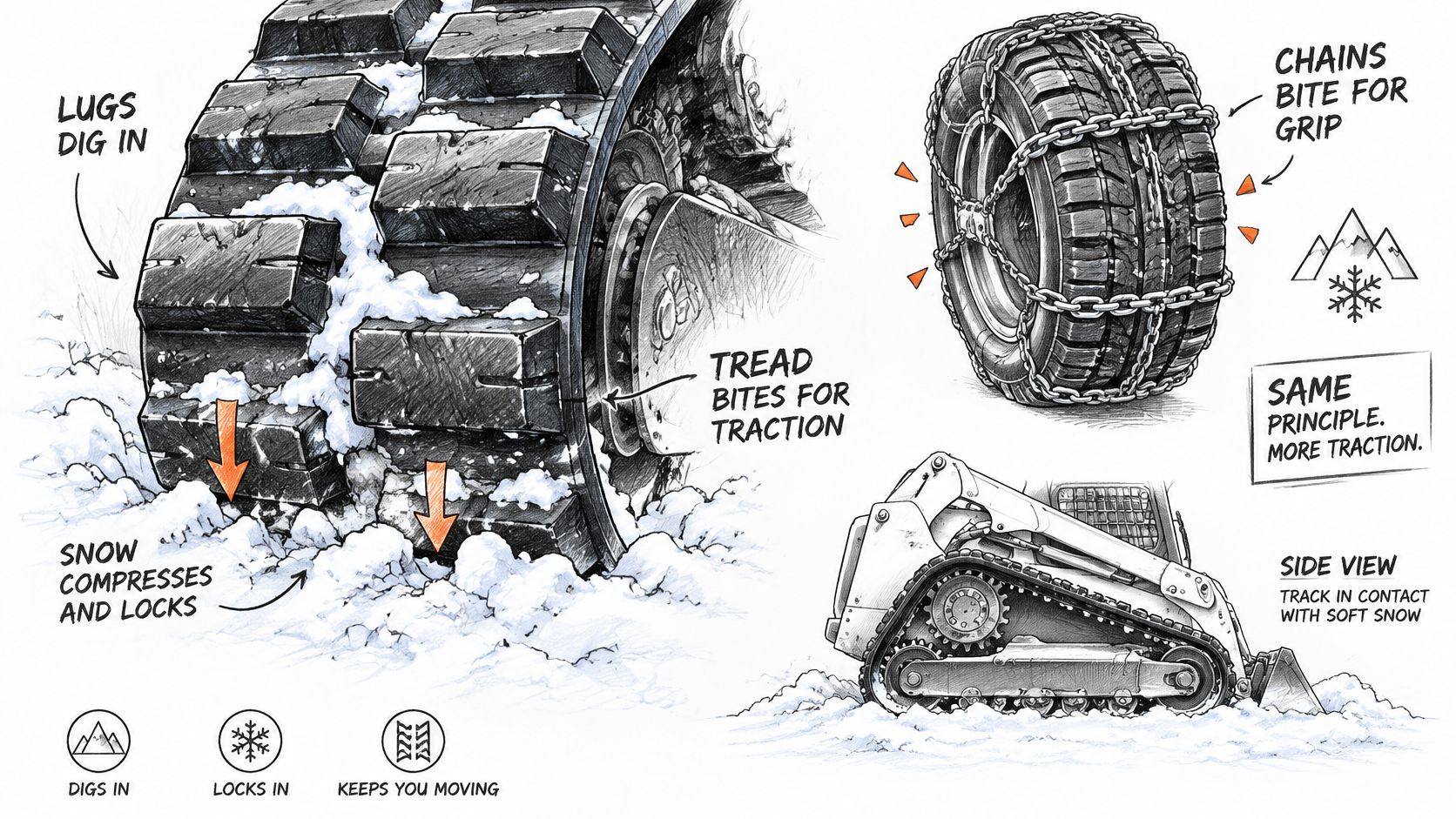
Bobcat's track-selection guidance treats tread geometry as a traction and productivity choice, not a cosmetic one.
Bar treads give more traction in snow and relatively low ground disturbance.
Zig-zag patterns are meant to improve grip in medium- to low-impact snow work.
Both beat a conventional block tread when snow is the main job, because a tread that cleans itself keeps the lugs engaged as snow is compressed and pushed aside.
A packed void turns the track into a slick pad. Open gaps that throw snow out are what keep forward drive.
How each family behaves
A linear or snow-focused tread adds edge contact so the track slips less on ice instead of digging a trench.
One manufacturer describes a stepped tread as improving cleanout and running smoothly during snow removal.
Block patterns still belong on dirt and grading.
They pack up in wet snow and lose bite.
| Tread family | Behaviour in snow | Best use | Main trade-off |
|---|---|---|---|
| Block (conventional lug) | Snow packs between blocks; weaker bite | Dirt, grading, mixed work | Poor self-cleaning in snow |
| Bar | Engages snow, strong traction, low ground disturbance | Plowing paved surfaces and loading snow | Less cushioning on rough ground |
| Zig-zag | Medium grip across mixed snow | Medium to low-impact snow work | Less aggressive in deep, wet snow |
| Linear or snow-focused | Higher edge contact, less slippage | Icy, hard-packed surfaces | Limited benefit in deep, loose snow |
| Stepped | Improves cleanout and smooth running during snow removal | Frequent-stop snow removal | Confirm abrasion life with the maker before you buy |
What I would prioritize
If the loader will plow, blow, or load snow for long stretches on pavement or slopes, I would start with a snow-rated bar or zig-zag, not a general block.
Before you order, ask how the voids clean in wet snow. A pretty lug that packs solid by the second pass will not earn its keep.
On firm or icy ground a narrower contact width puts the available push on a smaller strip.
Save the wide footprint for deep or soft snow, where staying on top matters more than concentrating force.
Rubber compound and carcass construction sit under the tread.
A pattern that grips but cannot carry the loader's localized drive-lug loads will chunk, tear lugs, or fatigue the steel embeds long before the season is over.
Why Track Width Changes Flotation and Push
Deep, wet snow decides whether a loader rides on top or digs its own hole.
A wider track spreads machine weight over more rubber, so ground pressure drops and the machine stays nearer the surface.
A narrow track does the opposite: less rubber on the ground, more pressure under it, more bite through to a firm base.
That is the trade-off.
On ice or packed pavement, a narrower footprint concentrates push on a smaller strip and usually turns cleaner.
In fresh or wind-blown snow, that same footprint punches through and spins. More ground-contact points along the track help traction for pushing and turning, but they cannot make up for choosing the wrong width for the main surface.
Reading width, pitch, and link count
Three numbers on the track label have to match the machine before width is even a choice:
- Width is the rubber measured across the track.
- Pitch is the center-to-center distance between links.
- Link count is how many links make the loop.
A Cat 259D spec of 400x86x53 means 400 mm wide, 86 mm pitch, 53 links.
Compare a 320 mm track with a 450 mm track only after pitch and link count already suit that undercarriage.
Read any full size the same way, including a 450x86x56 track listing: width first, then pitch, then links.
Width follows the dominant condition, not the size of the cab.
Stay narrower when the route is mostly firm, step up when deep loose snow dominates, and confirm frame clearance, added weight, turning scrub, and even side-to-side wear before ordering.
How Machine Setup and Attachments Change Track Demands
Snow performance is not the track by itself. The machine and the attachment set the load those lugs have to carry.
A straight blade loads the tracks through push and through every turn at the end of a pass.
Weak tension and a dirty undercarriage show up as steering scrub before they show up as a stuck machine.
A box plow or pusher holds a pile, so the drive lugs see sustained push instead of short bites.
A scoop or a loaded bucket puts high localized force through those same lugs.
If the track grips but is not built for the loader's rated capacity, you trade traction for torn lugs and a tired carcass.
A snow blower is a different stress.
The machine has to keep rolling while the attachment pulls hydraulic power.
Newer loaders often offer high-flow and super-flow hydraulics for that work.
An older machine can stall under a large blower even when the tracks look fine, because the limit is oil flow, not tread.
A 2025 market projection cited by DXC puts the global skid-steer snow-blower attachment market at $249.0 million in 2025, rising to $414.9 million by 2034 at a 5.8% compound annual growth rate.
More blowers on compact loaders means more jobs where stable traction and hydraulic capacity have to show up together.
The same discussion notes that more ground-contact points improve traction for pushing and turning while lowering ground pressure.
Match the check to the tool
- Blade or pusher: Even tension on both sides, and a turning check before you load the pile. These tools expose slack and packed idlers.
- Blower: Stable traction on the packed path, plus enough hydraulic flow that the tracks are not asked to drag a stalled head.
- Loaded bucket: Confirm rated operating capacity against the heaviest scoop you will carry, not the empty machine.
Replace tracks as a pair.
Uneven tread or uneven geometry loads the steering and the drivetrain on every skid turn.
After the storm, cleaning and a tension check belong with the attachment you ran, not as a generic "aggressive track" wish.
How to Prepare and Run Tracks Through a Snow Event
Once the tread and width are chosen, the storm itself is a sequence.
Rubber compound and how hard you run the machine decide whether that grip lasts.
McLaren Industries winter-track guidance separates linear, snow-focused treads from patterns that struggle in severe cold.
A linear tread can increase edge contact with snow and ice, cut slippage, and avoid digging in.
Advanced winter compounds pair that grip with load-bearing strength, which matters because a compact track loader sends high localized force through the drive lugs while it carries an attachment or a full bucket.
A track that bites but is not rated for that load can fail at the lug, the carcass, or the steel embed.
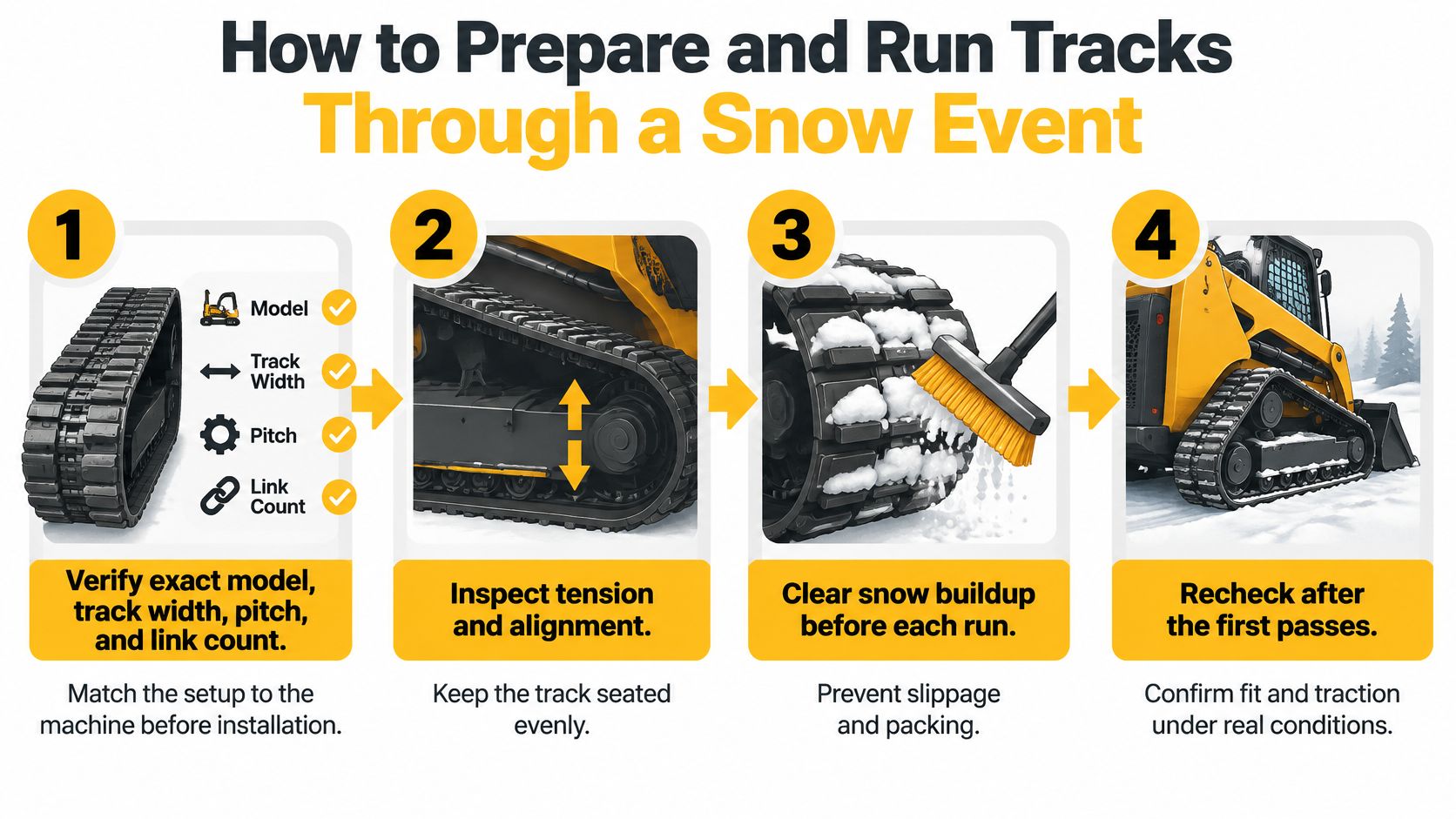
- Verify model, width, pitch, and link count before the first storm. A track on the wrong frame or the wrong pitch wears on one edge and walks off the idlers.
- Inspect both tracks together. Look for cuts, missing chunks, and uneven lug height. The pair has to match. Unequal geometry increases steering scrub and drivetrain load.
- Set tension to the machine spec, then recheck it after the first thaw-freeze cycle. Cold rubber and packed ice both change how tight the loop feels.
- Drop travel speed on icy slopes. Tread cannot erase the loss of friction that ice puts under the rubber. Edge contact helps. It does not repeal ice.
- Use a bar or linear pattern on asphalt, and ease off when the attachment is near rated capacity. Deep, wet snow still wants self-cleaning voids. Asphalt wants a smoother, lower-disturbance ride.
- Clear packed snow and ice from the undercarriage, drive sprockets, and rollers after each storm so the next start is on rubber, not on a frozen sleeve.
- Log what you see: chunking, lug tears, and wear that is worse on one side.
This walk-through shows the same checks on a machine, from fit through a tension look after the first passes.
What the symptoms mean
A track that slips in snow usually has packed voids, not a weak engine.
A machine that steers poorly after a storm often has unequal tension or unequal wear.
Replace in pairs when one side is ahead of the other, and write the tension reading down so you can see drift before a lug lets go.
On ice, slow down even with the right tread. Edge contact reduces slip. It does not restore summer friction.
Confirm Track Specs and Warranty Before You Order
The path is short.
The surface mix decides tracks or tires. Snow depth and the surface under it choose tread and width.
The machine and the attachment confirm the load.
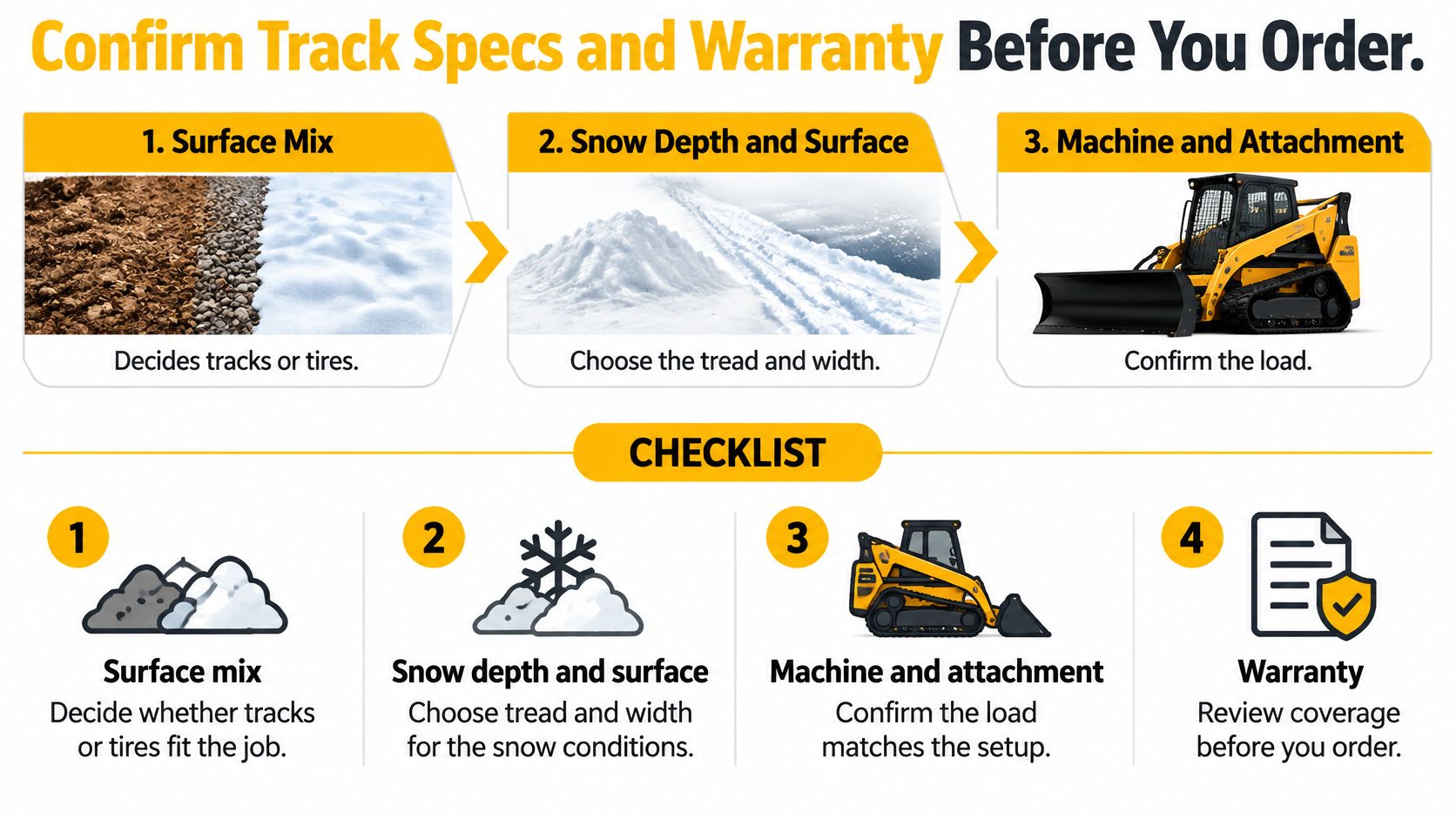
Before you order, write these down:
- Machine identity: make, model, and serial number.
- Track size: width, pitch, and link count, read from the track on the machine or from the manual. Our track measurement guide walks through that label so a 320 mm and a 450 mm comparison stays on the same pitch and link count.
- Tread family matched to the dominant snow in the condition table, not to a generic "winter" label.
- Rated operating capacity set against the heaviest blade, bucket, or blower you will hang.
- Season mix: the share of hard surface versus deep snow across a full winter.
- A matched pair, so steering and drive loads stay even.
- Stated application: temperature, pavement exposure, and attachment load the track is built for.
DirtPusher sells aftermarket rubber tracks for skid steers, compact track loaders, and mini excavators, sold as pairs, with fitment help from make, model, and serial number, and a 12-month warranty on defects in materials and workmanship.
Write the machine details and the snow mix first, match them to the condition table, then talk to a fitment person with those notes in hand.
If you are matching tread and width to a real winter route, DirtPusher carries replacement rubber tracks for skid steers and compact track loaders, sold as pairs, with help confirming fit before you order.
Bring the width, pitch, link count, and the snow you push, and we can line that up with a track built for the job.
Start at DirtPusher.