

The U.S. rubber-track market was estimated at USD 525.3 million in 2024, according to P&S Intelligence. A meaningful slice of that money is spent twice, because a replacement belt gets ordered on width alone, fitted over hooked sprockets, tensioned by eye, and then blamed when it throws a few hundred hours later.
None of those failures are mysterious. They're the predictable result of treating tracks for excavator as a parts-number lookup instead of an undercarriage decision. Match three dimensions exactly, inspect the parts the belt runs on, set tension to a measured sag, and divide the pair price by realistic hours. That sequence separates a track that pays for itself from one that just postpones a bigger bill.
Table of Contents
- Replacement Track Sizes for Common Excavators
- Rubber and Steel Tracks Compared by Job Surface
- How to Measure Your Current Track
- Inspect Sprockets, Rollers and Idlers Before You Buy
- How to Set Track Tension After Replacement
- Why Tracks Derail or Fail Early
- Cost per Hour Beats Pair Price
- Confirm Model and Size Before You Order
Replacement Track Sizes for Common Excavators
The table below lists the three numbers that identify a replacement track on common compact excavators, and each size is sold as a pair rather than a single belt.
| Track fits | Width (mm) | Pitch (mm) | Link count |
|---|---|---|---|
| Cat 259D | 400 | 86 | 53 |
| Cat 259D | 320 | 86 | 53 |
| Cat 239D | 320 | 86 | 49 |
| Cat 249D | 400 | 86 | 49 |
| Cat 279D | 400 | 86 | 56 |
| Cat 289D | 450 | 86 | 56 |
| Cat 305E2 CR | 400 | 72.5 | 76 |
| Case 440CT | 400 | 86 | 50 |
| Bobcat E32 | 300 | 52.5 | 80 |
| Bobcat E35 | 300 | 52.5 | 84 |
| Bobcat E60 | 400 | 72.5 | 76 |
| Bobcat T200 | 320 | 86 | 52 |
| Bobcat T300 | 450 | 86 | 55 |
| Bobcat T630 | 400 | 86 | 52 |
| Bobcat T650 | 320 | 86 | 52 |
| Kubota U35 | 300 | 52.5 | 84 |
Read a size such as 400x86x53 left to right: 400 mm of width, 86 mm of pitch, 53 links. Width is the rubber belt measured across its face, excluding the drive lugs. Pitch is the center-to-center distance between drive lugs, the one dimension that has to mesh with the sprocket teeth. Link count sets how much belt length the tensioner has to work with.
Why two machines with the same decal need different belts
The Cat rows show how quickly model-only ordering goes wrong. A Cat 259D runs either a 400x86x53 or a 320x86x53, depending on which undercarriage and boom setup the machine shipped with, so two loaders with identical decals can take different pairs. The Bobcat E32 and E35 sit at the same 300 mm width and 52.5 mm pitch but not the same length: 80 links against 84. Fit the E32 belt to an E35 and the tensioner runs out of adjustment before the sag ever reaches spec.
Cross-brand matches are normal when the numbers line up. A Cat 305E2 CR and a Bobcat E60 both take 400x72.5x76, and a Kubota U35 shares 300x52.5x84 with the Bobcat E35. Wider frames step up to 450 mm, as on the Bobcat T300 at 55 links and the Cat 289D at 56.
Practical rule: width gets you close, pitch gets you fitted, link count gets you tensioned. Get any one of the three wrong and the pair goes back on the pallet.
Find the row for your machine, then confirm those same three numbers on the track currently in place before ordering. Sizes and pair listings for these machines sit in our mini excavator tracks collection, and the measuring steps below show how to verify a belt that's still on the machine.
Rubber and Steel Tracks Compared by Job Surface
The ground under the machine decides the track, not the other way round. The same belt that survives two seasons on a landscaped estate can be chewed through in weeks on a demolition site, because hard, abrasive contact loads the rubber far harder than soft soil ever does.
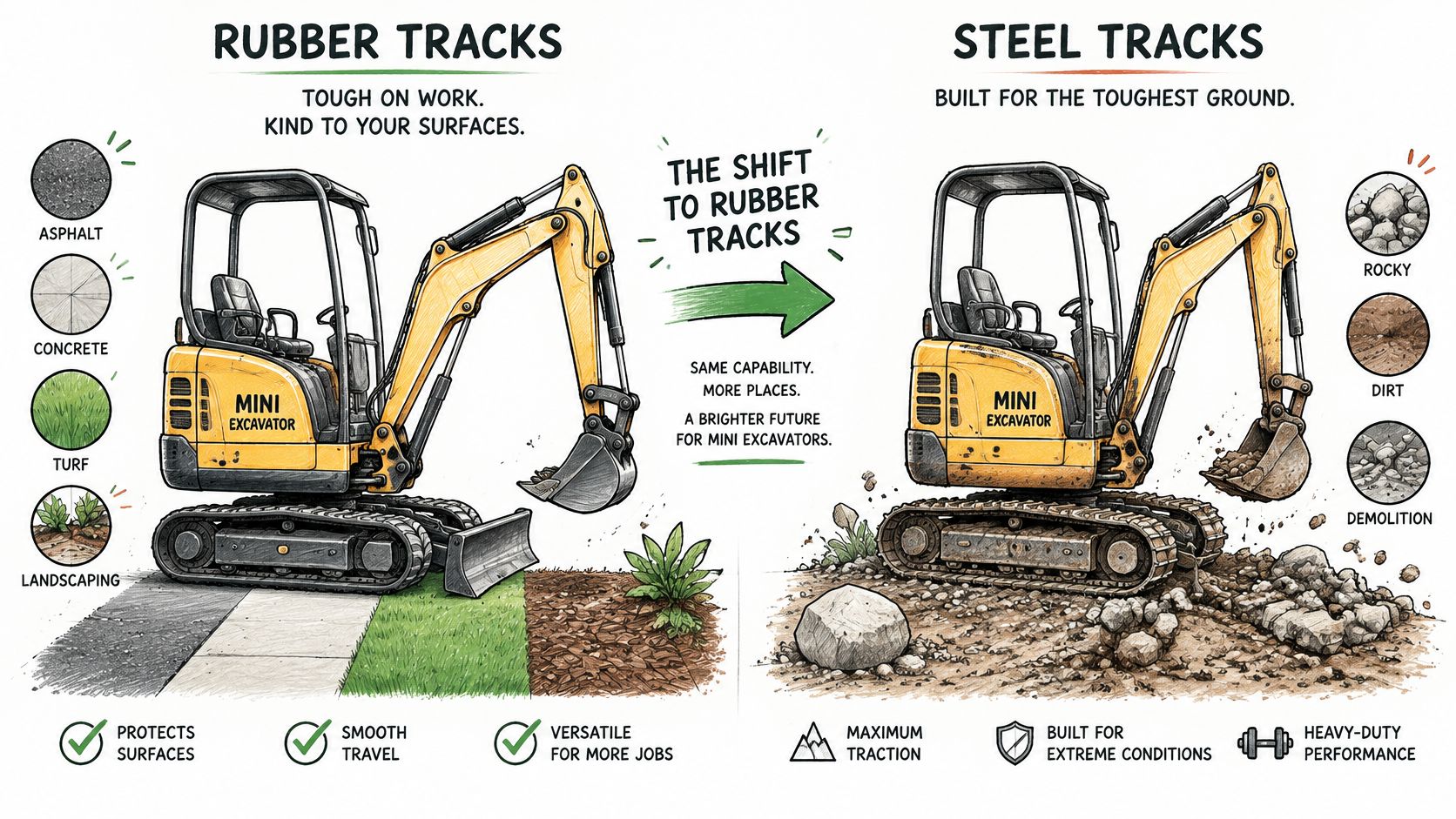
A rubber track isn't a solid band of rubber. Steel cords run through the carcass and embedded metal components carry the machine's weight, while the rubber itself absorbs contact and keeps the load off the surface underneath. That construction is what lets a compact machine cross asphalt, concrete or finished turf without gouging it.
| Job surface | Suited track approach | Main wear risk |
|---|---|---|
| Asphalt or concrete | Rubber track | Tread and rubber deterioration under continuous use |
| Turf and landscaped ground | Rubber track | Surface damage if the track isn't matched to the job |
| Compacted gravel | Rubber track | Tread abrasion |
| Abrasive ground or sharp rock | Ask fitment support about a heavier-duty undercarriage | Cuts and high shear on the belt |
| Demolition debris | Ask fitment support about a heavier-duty undercarriage | Edge loading and punctures |
| Sustained slope work | Rubber track with more frequent checks | Higher shear and bending load on the belt |
Mini excavators accounted for 35% of the global rubber-track market in 2024, per P&S Intelligence, which tells you where most replacement volume and most fitment questions sit.
Consider two scenarios. A contractor runs a 3-ton machine across established lawns, driveway aprons and fresh grading, where flotation and a clean footprint are the whole point of the machine. A demolition crew runs the same size machine through broken slab, rebar and rip-rap, where the belt is asked to survive edges that cut and lever. The contractor's belt spends its life being protected by the surface. The demolition belt spends its life being attacked by it.
Selection rule: rubber suits flotation and surface protection. Severe rock or rip-rap exposure calls for more frequent inspections and may justify a different undercarriage entirely.
How to Measure Your Current Track
Three numbers and a data plate, measured with the track still on the machine. Fifteen minutes of work here removes most of the guesswork from the order.
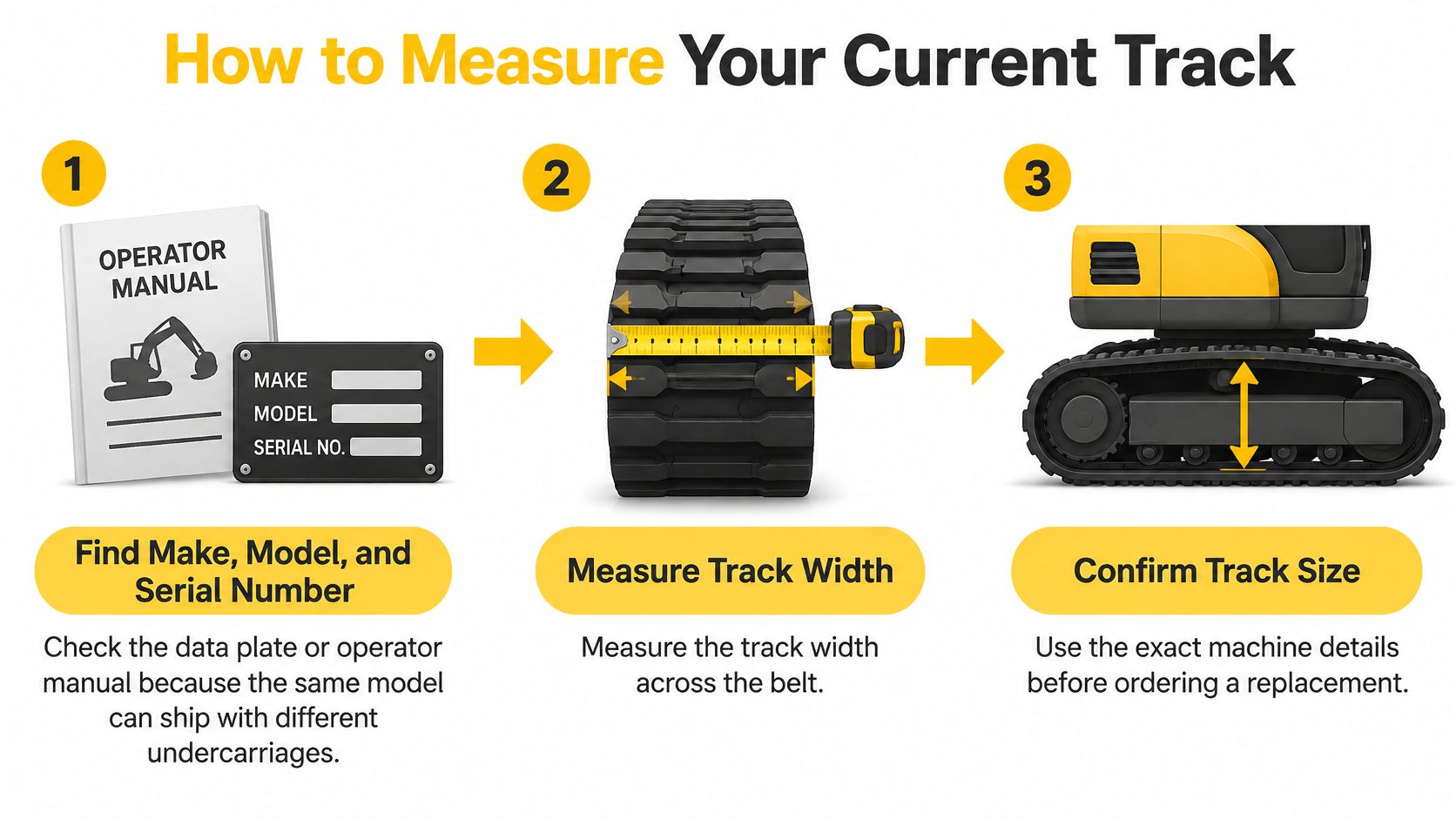
- Start at the data plate. Write down the make, model and serial number from the plate or the operator manual. The same model can ship on more than one undercarriage, and the serial number pins the build. The common slip is trusting a repainted hood decal or a seller's description instead of the plate.
- Measure width across the belt face. Use a tape in millimeters across the rubber, excluding the drive lugs and any center guide lugs. Measuring at a feathered, worn edge adds a few millimeters that don't exist. Measure in the middle of a clean section.
- Derive pitch from ten lugs. Measure from the center of one drive lug to the center of the lug ten spaces along, then divide by ten. Averaging across ten gaps cancels out most hand-measurement error. Measuring a single gap is where pitch readings go wrong.
- Count every lug around the loop. Mark the first drive lug with paint or a paint pen and work around one side until you're back at the mark. The slip here is double counting where the count restarts, which throws the total off by one or two links and makes the tensioner useless.
- Check the drive-lug pattern and center guide. The lug shape has to match the sprocket profile, and any center guide has to sit in the idler flange. Two tracks with identical width, pitch and link count can still differ at the guide.
- Match all three numbers before you order. Compare against the size table and the manufacturer listing, and buy only on an exact match.
The stretched-track trap
A worn belt measures longer in pitch than the specification, because the steel cords and rubber have taken a permanent set. Measure a five-year-old track against its own worn lugs and you'll order a size that never fit. Work from the manufacturer specification and check the reading against the sprocket, not against the belt you're replacing. Our guide to measuring a rubber track walks through the same steps with the tape positions marked.
Inspect Sprockets, Rollers and Idlers Before You Buy
A new belt on tired running gear is money spent twice. Equipment World's undercarriage guidance makes the mechanism clear: replacing only the belt while keeping worn engagement parts transfers abnormal loads into the new track and shortens its service life. The belt is the cheapest part of the system to replace and the most expensive part to replace twice.
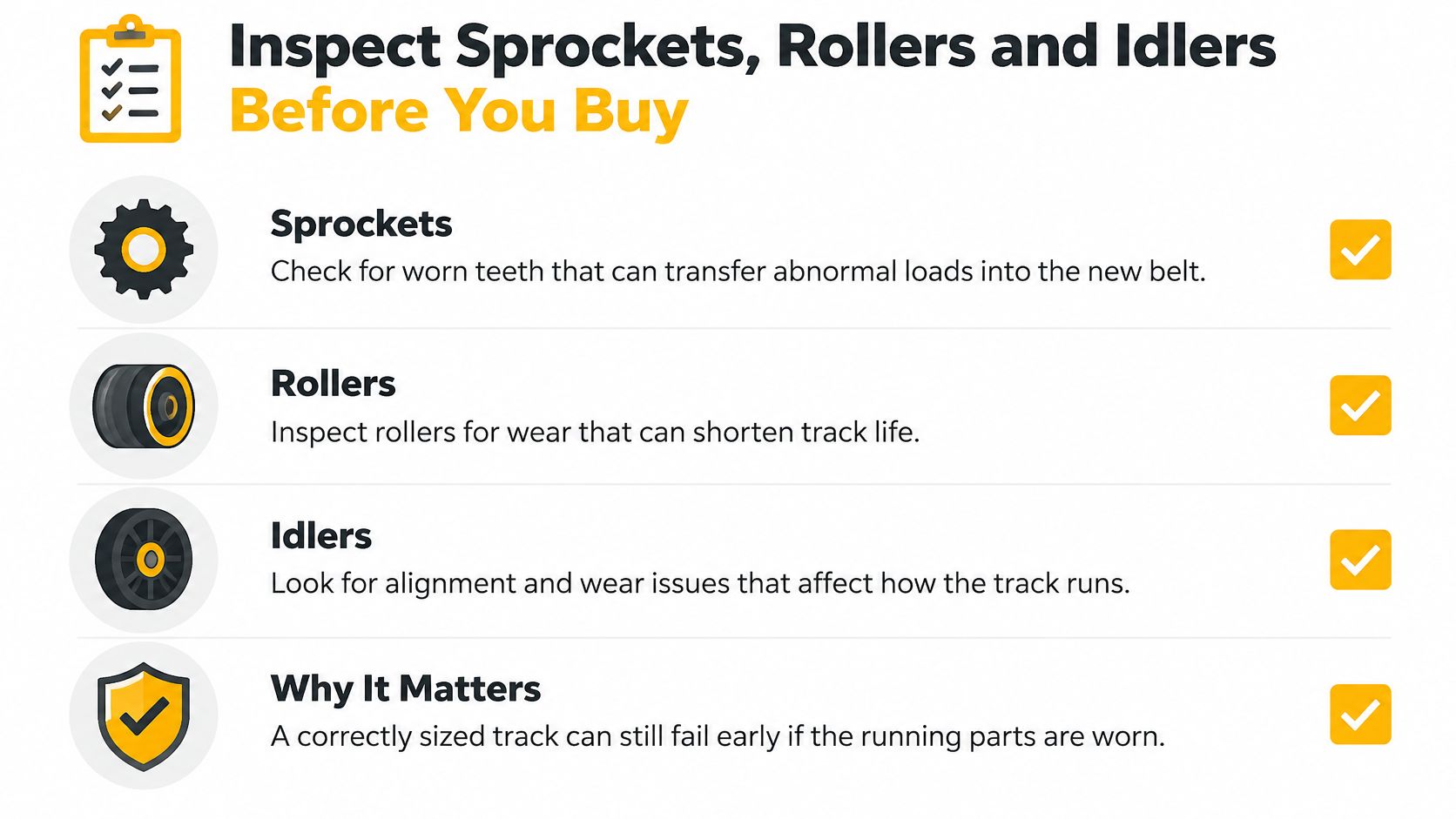
Run this checklist with the old belt off, or with the machine lifted so each component can be turned by hand.
- Sprocket teeth: compare the profile against a new sprocket for the model. Teeth that have gone from rounded and symmetrical to hooked and pointed will skip under load instead of engaging the lugs.
- Track rollers: spin each roller and listen. A roller with a flat spot, a seized bearing or a grease leak is finished, and it will cut a groove in the new belt's inner surface.
- Idlers: check the center flange for wear and the bearing for play. A wobbling idler is subtle on the ground and obvious once the machine is lifted.
- Carrier rollers: same test as the bottom rollers, and easy to forget because they sit up out of the dirt.
- Track frame: look for cracks, old weld repairs and anything that suggests the frame took a hit. A bent frame steers the belt sideways no matter how correct the tension is.
Replace-together rule: if the sprockets or rollers are past the manufacturer's wear limit, do them in the same job. The machine is already down, the tools are already out, and the labor is already on the clock.
For a rental fleet, this inspection is easiest to schedule at each track change rather than as a separate service, which is exactly when a repeat failure is cheapest to prevent. Wear parts for the whole assembly sit in our undercarriage parts collection.
How to Set Track Tension After Replacement
Tension is a measurement, not a look. A belt that appears drum-tight can be loaded far past spec, and one that looks fine can be slack enough to climb over the sprocket on a pivot turn. Kelbe Bros' track tension guidance treats it as a controlled operating variable: too much tension raises rolling resistance and concentrates load at the sprocket, rollers and belt, while too little allows movement, misalignment and sprocket disengagement.
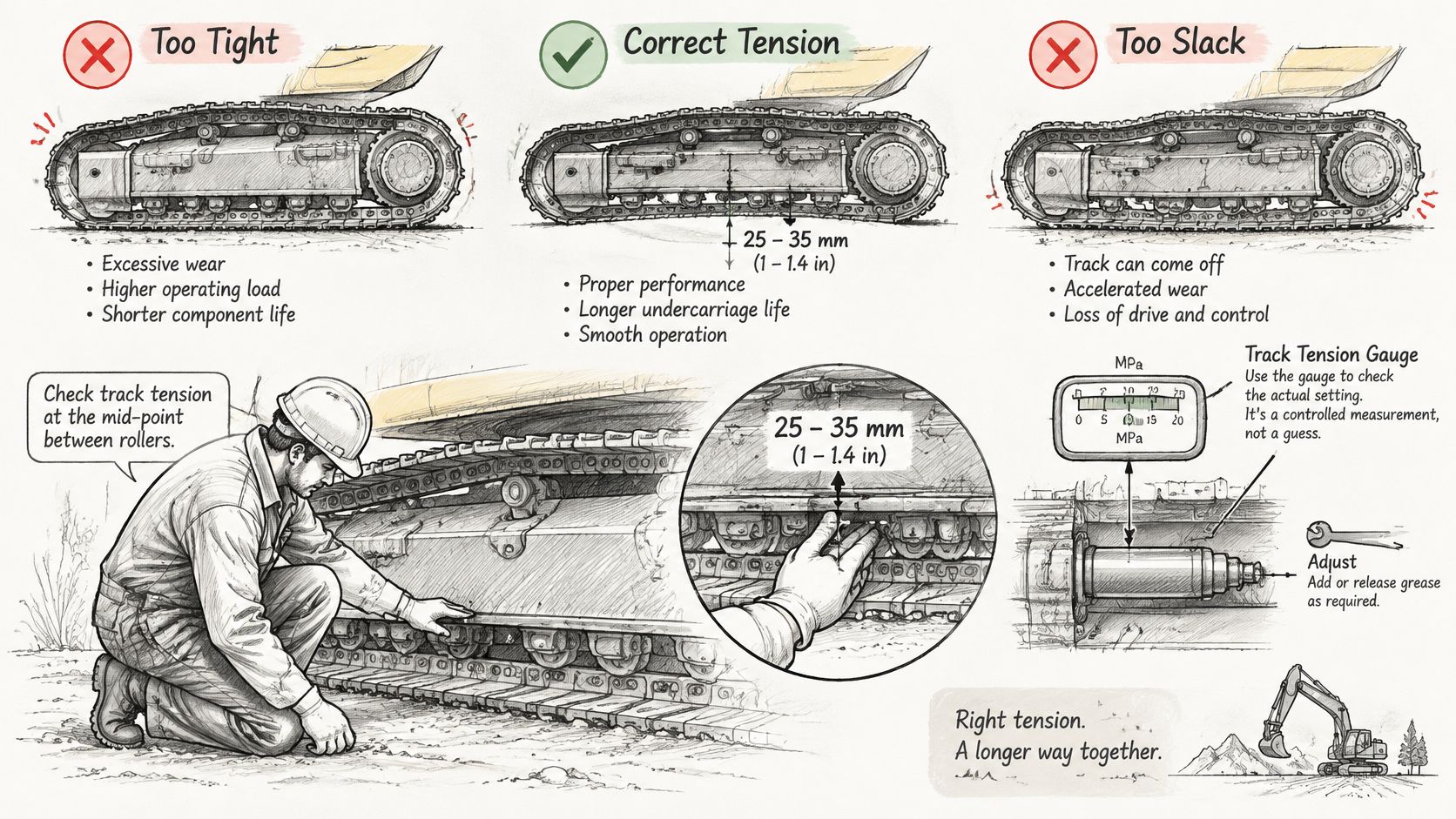
- Rotate the track slowly to push the slack to one run before you measure anything.
- Measure sag at the point the manual specifies, typically between the front idler and the sprocket, using a straight edge and a ruler.
- Adjust to the machine specification only. Another owner's number for a similar machine is not your number.
- Recheck after the first 30 operating hours. New rubber beds in and stretches, and that first interval catches most of it.
- Recheck every 50 hours after that, and any time the machine has been worked hard.
- Recheck after cleaning or after working in mud. Packed material tightens a track on its own, so a reading taken with clay in the undercarriage tells you nothing useful.
Wash before you measure, then measure again. Packed grit grinds the belt and packed mud inflates the tension reading. Clean with a pressure washer at moderate pressure, aimed away from seals and bearings, and take the sag measurement on a clean undercarriage.
When sag can't be brought within specification, or when the track keeps loosening between checks, that's the point to book an undercarriage measurement by a technician rather than adding more grease and hoping. A tensioner that bleeds off is telling you something about seals, not about the belt.
Why Tracks Derail or Fail Early
Rubber tracks went mainstream on compact machines in the 1970s, when Bridgestone's engineers pioneered them for excavators, and the company's field surveys since have produced a number worth taping to the shop wall: about 30% to 40% of track failures were associated with steel-cord breakage in the overlap area, per Bridgestone's technical guide.
What the overlap hides
The overlap is where the belt's ends are joined, and the steel cords there carry load in a way the rest of the carcass doesn't. A crack or split in that zone can open up behind tread that still looks serviceable, which is why judging wear from the visible surface misses the failures that matter most. Inspect the full structure, both edges and the overlap included, not just the tread blocks.
| Symptom | Likely cause | Fix |
|---|---|---|
| Track rides off the sprocket or idler | Track too loose or worn sprocket teeth | Re-tension to spec and replace worn sprockets |
| Cracked or split belt near the overlap | Steel-cord breakage in the overlap area | Replace the track and inspect the full structure |
| Hot or seized rollers | Worn or failing rollers | Replace the rollers before fitting the new track |
| Rapid wear on one side | Frame misalignment or uneven tension | Check alignment and tension on both sides |
| Track slaps or sags | Too loose or packed mud | Clean, then measure sag and adjust |
| Missing tread chunks | Sharp rock, debris or abrasive ground | Clean the track, change the work area and inspect more often |
Four root causes keep turning up behind those symptoms: tension that's wrong or packed with mud, sprocket teeth worn past their profile, a frame that isn't square, and sharp debris wedged where the belt runs. Each one has a fix that costs parts or an hour of labor, and none of them is solved by bolting on a fresh belt.
When the cause lives in the undercarriage, a new track alone won't fix it. It just gives the worn parts something expensive to eat.
Cost per Hour Beats Pair Price
The cheapest pair is rarely the cheapest track. Track costs can run roughly 30 to 35% of an excavator's lifecycle cost, and reported track life ranges from about 3,000 to 6,000 operating hours in some conditions to 4,000 to 8,000 hours in others, because soil, moisture, travel patterns and operator technique change wear rates, as Equipment World's undercarriage analysis sets out.
A spread that wide makes pair price almost meaningless on its own. Divide it by hours and the picture sharpens.
| Expected track life (hours) | Cost per hour at $1,000 pair | Cost per hour at $1,500 pair |
|---|---|---|
| 3,000 | $0.33 | $0.50 |
| 6,000 | $0.17 | $0.25 |
| 8,000 | $0.13 | $0.19 |
The comparison that matters is diagonal, not vertical. A $1,500 pair lasting 8,000 hours costs $0.19 per hour, while a $1,000 pair lasting 3,000 hours costs $0.33. The dearer set is the cheaper track by nearly half, and that's before counting the downtime and the undercarriage damage from a belt that gave up early.
The question to ask before the price: can this undercarriage deliver the hours I'm about to divide by?
Run the calculation on your own machine rather than on someone else's numbers.
- Note the pair price for the sizes your machine takes.
- Estimate realistic hours for your ground, your travel patterns and your operators, keeping in mind that hard finished surfaces protect the surface and punish the tread.
- Divide, and compare. Two or three candidate tracks, ranked on cost per hour, is a decision you can defend to a fleet manager.
- Add the parts being replaced in the same job. Sprockets and rollers belong in the same total, because they're the difference between a track that reaches its expected life and one that doesn't.
Confirm Model and Size Before You Order
Everything below gets confirmed before the order goes in, and none of it takes longer than a phone call.
- Machine identity. Make, model and serial number from the data plate or the operator manual, not from memory or a listing photo.
- The three measurements. Width, pitch and link count, taken as described above and matched exactly to the sizing table.
- Running gear condition. Sprockets, rollers and idlers checked, and anything past its limit added to the same order.
- The tension setting for the new belt, noted from the manual so the first recheck happens on schedule rather than after a derailment.
Tracks ship as pairs, so both sides are ordered together, which is important: one worn side and one fresh side causes uneven tension and uneven wear from day one. DirtPusher sells aftermarket rubber tracks for skid steers, compact track loaders, and mini excavators, with listings for Bobcat, Cat, Kubota, John Deere, Takeuchi, and Case machines, including the Bobcat E32, E35, E50, and E60, such as the E35 300x52.5x84 pair at $669.
If any number is unclear, our fitment help runs by phone or text off the make, model and serial number, and the track size finder handles the straightforward cases. Getting the size confirmed before checkout is cheaper than freight both ways.
The difference between a track that reaches 8,000 hours and one that fails at 2,000 usually isn't the belt, it's the fitment and the running gear underneath it. DirtPusher sells aftermarket rubber tracks for mini excavators, skid steers and compact track loaders, organized by width, pitch and link count and sold as pairs, with fitment help by phone or text using your make, model and serial number. Send us the machine details before you order so the size gets confirmed against your undercarriage, then start at DirtPusher.