

In a 300 x 52 listing, 300 is the track width in millimetres and 52 is the pitch, usually 52.5 mm. The link count is not in that shorthand, so you confirm it separately before you treat the size as complete.
Why do so many used skid steer tracks still show up with the wrong loop length when the ad already prints two numbers? Buyers read 52 as the number of links. It is not. Pitch and link count are different measurements, and a listing that drops one of them is unfinished. Width, pitch, and links have to agree with the track in your hands and with the machine manual. Only then does sticker price mean anything, because remaining hours, not the asking price, decide what you will spend per hour of work.
Table of Contents
- What the Numbers in a 300 x 52 Track Size Mean
- How to Measure Width, Pitch and Link Count
- Track Sizes for Common Used Machines
- Reading Tread Wear, Cuts and Missing Lugs
- Tension and Sprocket Checks That Affect Fit
- Cost per Operating Hour, Not Just Price
- Seller Questions That Confirm Provenance
- Confirm the Size Before You Order
What the Numbers in a 300 x 52 Track Size Mean
In 300 x 52, the first number is width and the second is pitch. Link count is the missing third number.
Width is the distance across the belt from edge to edge, in millimetres. 300 mm is about 11.8 inches. You measure the carcass, not the outer tips of worn tread blocks.
Pitch is the centre-to-centre distance from one drive lug or cross bar to the next. Listings usually print it as 52.5 mm. The shorthand drops the decimal and reads 52. That 52 is still a length in millimetres. It is not a count of links.
Link count is how many links run around the loop on one side. A 300 x 52 code does not contain it. The size stays incomplete until you confirm the count. A full code such as 300 x 52.5 x 80 names all three: 300 mm wide, 52.5 mm pitch, 80 links.
| Position | Measures | Unit | Example: 300 x 52.5 x 80 |
|---|---|---|---|
| First number | Track width across the belt | mm | 300 |
| Second number | Pitch, centre to centre of drive lugs or cross bars | mm | 52.5 |
| Third number | Link count around the loop, one side | links | 80 |
The same chain shows up on a larger track. 400 x 86 x 53 means 400 mm wide, 86 mm pitch, and 53 links. Nothing in the code is optional, and nothing swaps places.
Why width comes first
Width is the number people most often misread from a chewed edge. A width error means the track will not seat on the rollers, no matter how close the other two numbers are. Pitch and link count then set the loop length that has to match the sprocket spacing and the undercarriage.
Working rule: If a listing gives only two numbers, treat link count as unknown until you measure it or the seller confirms it.
How to Measure Width, Pitch and Link Count
Clean the track and get it flat before you trust any number. Mud, twist, and a worn edge will move every reading.
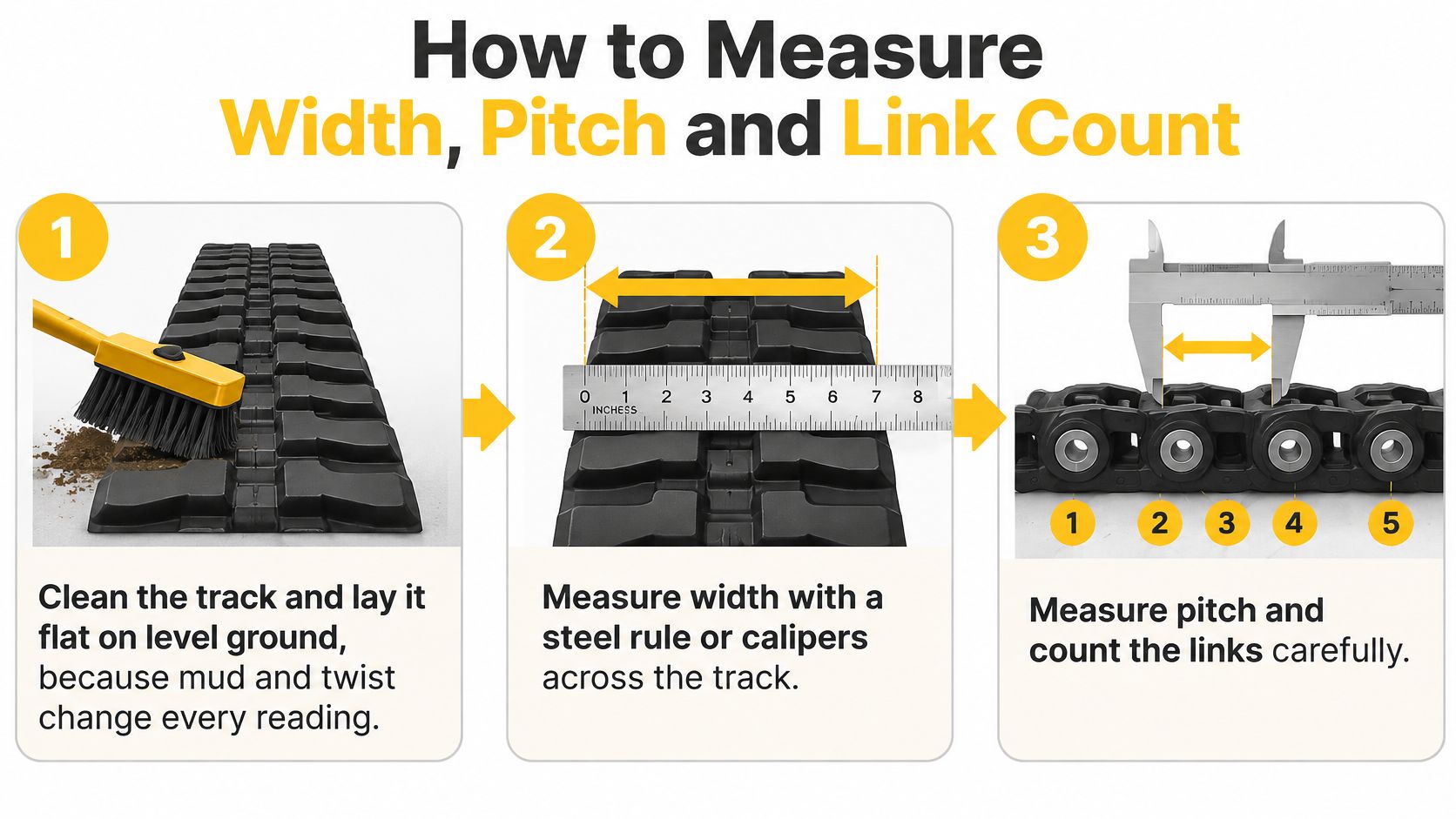
The rubber track measurement guide walks the same three checks. Use a steel rule or calipers, and write each result down before you move to the next.
- Clean and lay the track flat. Wash off clay and set the loop on level ground. Packed dirt changes the apparent width, and a twisted belt shortens the span you will call pitch.
- Measure width at the centre of the inner belt. Stay off the worn outer edge. Take two readings and average them. A chewed edge understates width, and that undersized number is how a 320 mm track gets ordered as a 300 mm track.
- Measure pitch across ten spaces. Mark one drive lug, count forward ten lugs, and measure centre to centre. Divide that span by ten. A 300 x 52.5 track should read close to 52.5 mm. Dividing the same span by nine, because you counted the starting lug as one of the spaces, overstates pitch by about 11 percent.
- Count every lug on one side. Start at your mark and count each lug or cross bar until you return to it. Do not count the starting mark twice. A 300 x 52.5 x 80 track should count 80.
- Check the loop length. Multiply pitch by links. 52.5 mm x 80 is about 4,200 mm around the loop. If your tape around the inner path is far from that figure, one of the two inputs is wrong.
- Write the full code and the tread. Record width x pitch x links, then note whether the tread is block, multi-bar, or another pattern. Tread style is not part of the size code, so two tracks with the same three numbers can still be different products.
- Match the manual before you order. The three numbers have to agree with the operation manual for that serial number. A close pitch on the wrong link count will not tension correctly.
What a sound reading looks like
You finish with three numbers that match the manual, and a loop length that matches pitch times links. If width, pitch, or the count fights the manual, stop and remeasure. Do not average your way to a size the machine does not use.
Track Sizes for Common Used Machines
Used machines keep changing hands, and the track that left the factory is often gone. Total Landscape Care, citing Fusable's EquipmentWatch data, reported that used skid steer sales fell 8.7% to 8,737 units from March 1, 2024, through February 28, 2025. That is still thousands of machines entering a new owner's maintenance cycle each year. Model name alone will not tell you the track.
Read each row as width x pitch x links for one configuration. Measure the track you have, then find the row. Do not start from the brand and guess.
| Machine | Track size (width x pitch x links) |
|---|---|
| Bobcat E32 | 300 x 52.5 x 80 |
| Kubota U35 | 300 x 52.5 x 84 |
| Kubota KX121-3 | 350 x 54.5 x 86 |
| Bobcat E60 | 400 x 72.5 x 76 |
| Cat 305E2 CR | 400 x 72.5 x 76 |
| Cat 259D | 320 x 86 x 53 |
| Cat 259D | 400 x 86 x 53 |
| Cat 279D | 400 x 86 x 56 |
| Kubota SVL75 | 320 x 86 x 52 |
| Bobcat T630 | 400 x 86 x 52 |
| Cat 289D | 450 x 86 x 56 |
| Bobcat T300 | 450 x 86 x 55 |
| Kubota SVL95-2s | 450 x 86 x 58 |
| Cat 299D | 450 x 86 x 60 |
Same width, different machine
The Bobcat E32 and the Kubota U35 both run a 300 mm belt at 52.5 mm pitch. Link count splits them: 80 against 84. A seller who stops at "300 tracks" can ship the wrong loop. The Kubota KX121-3 steps up to 350 mm. Larger Cat and Bobcat models in this list run 400 to 450 mm.
The same model can wear more than one width. The Cat 259D appears here at both 320 x 86 x 53 and 400 x 86 x 53. A listing that says only "259D tracks" has not named the belt. Match the serial number and the operation manual first. Then set your measured track against the row. A Bobcat E32 300 x 52.5 x 80 pair is one example of a full code tied to one model, not a size that fits every compact machine with a Bobcat badge.
Reading Tread Wear, Cuts and Missing Lugs
Tread that still looks chunky can hide a carcass that will not hold tension. Grade a used track on several checks, not on how pretty the blocks look in a photo.
Walk the carcass for cuts, cracks, exposed reinforcement cords, missing steel embeds, and torn guide lugs. A track that cannot hold adjustment is damaged, even if the outer rubber still has shape. Also watch the machine, or ask the seller to, under correct tension. Repeated sprocket ratcheting or skipping points at embed wear or sprocket wear, not at a cosmetic scuff.
Depth limits are model-specific
Measure tread from the top of the grouser to the lowest adjacent track surface, using the method in that manufacturer's manual. A Caterpillar undercarriage guide identifies replacement at less than 8 mm of tread depth and less than 34 mm of track-bar forging. Those limits are model- and design-specific. They do not replace the manual for your serial number. The same guide says to measure sprocket tooth wear at three locations, average the readings, and replace the sprocket when the specified wear threshold reaches 75% or more.
Reject or discount heavily a track with structural damage, one that cannot hold adjustment, one that ratchets under correct tension, or one that will be paired with badly worn sprockets or rollers. A new belt on a worn undercarriage fails early.
Before you compare sellers, write a short list for each set:
- Carcass: cuts, cracks, exposed cords, missing embeds, torn lugs.
- Tension: holds adjustment, or it does not.
- Tread depth: your measurement, plus the manual's limit.
- Drive: ratchets or skips, yes or no.
- Mating parts: sprocket, roller, and idler condition in the same note.
That list is what you price, not the photo of the outer tread.
Tension and Sprocket Checks That Affect Fit
Tension comes from the service specification for that exact model. Generic sag figures are only a screen. A skid steer undercarriage maintenance guide describes smaller machines with roughly 3/4 to 1 inch of deflection, and larger units with up to about 2 inches, measured with the track centred over the rollers and a straightedge across the contact points. If your manual states a different figure, the manual wins.
Too much tension loads rollers, idlers, and bearings and stresses the steel cords inside the belt. Too little tension raises the chance of de-tracking, sprocket ratcheting, and torn guide lugs. Packed clay and mud change the effective tension, so you clean the undercarriage before you measure. A roller with a flat spot or a leaking seal will chew a fresh belt even when the size code is perfect.
Sequence before and after fitting
- Confirm the model spec in the operation manual for that serial number.
- Clean clay, rock, and wrapped debris out of the rollers and sprocket.
- Measure tension with the track positioned the way the manual describes.
- Inspect the sprocket and rollers. Measure tooth wear at several points and compare it with the manufacturer's threshold. Look for flat spots and leaks.
- Fit the track only after those parts are acceptable or already scheduled for replacement.
- Recheck tension after the first hours of work, then keep the daily walk-around for debris and odd wear.
A used track can measure correctly and still lose life quickly if the undercarriage is worn. That is why this check belongs in the buying decision, not after the belt is already on the machine.
Cost per Operating Hour, Not Just Price
A cheap set is often the expensive one to run. Engineer Fix puts a full replacement set of rubber tracks for a tracked skid steer at typically $3,000 to $5,000 in 2025. Use that range as the reference when a used set looks like a bargain.
Cost per operating hour is the total of track price, fitting, related undercarriage parts, and the downtime you expect, divided by the remaining working hours. Estimate those hours from tread depth left as a share of the usable depth in the manual, then cut the estimate if the carcass is cut or the sprockets are near replacement.
A worked comparison
Say one seller wants $1,200 for a set with about 30% of usable tread left. Spread across a full life, that is about $4,000 per full-life equivalent ($1,200 divided by 0.30). Another wants $1,800 with about 70% left, about $2,570 per full-life equivalent ($1,800 divided by 0.70). The higher sticker is the lower cost per remaining hour. Those two figures are examples, not quotes. To get cost per operating hour, divide your real total (tracks, fitting, sprockets, lost days) by the hours you still expect.
Hour meters lie when someone has swapped a cluster or run the machine off-book. Compare stated hours with pedal wear, cab wear, and cracks or repairs in the frame. If the machine came from a rental fleet, ask for surfaces worked and maintenance records before you accept the hours as the life story.
Compare cost per remaining hour, not the number on the listing.
Seller Questions That Confirm Provenance
Price comparison is useless until you know where the set lived. Rental penetration in U.S. construction and industrial equipment reached 57% in the first quarter of 2025, according to Mordor Intelligence. A rental history is common. Intensive work on abrasive or poorly kept sites can consume track life faster than the hour meter suggests.
Ask these before you rank the offers:
- Origin: Was this a rental unit, a contractor machine, or a farm machine? Rental, demolition, and rock work burn tread faster than light landscaping at the same hours.
- Surfaces: Dirt, gravel, concrete, rock, or a mix? Ask which attachments stayed on the coupler.
- Records: Tension checks, and any sprocket or roller replacements. A missing file is information.
- Hours versus wear: Do pedal, cab, and frame condition match the meter?
- Photos: Inner belt, carcass, guide lugs, and the centre of the tread, not only the outer face.
- Their measurements: Width, pitch, and link count taken on the listed track, with the method they used.
Note a refusal the same way you note a bad measurement. Keep one short answer sheet per seller so every offer uses the same remaining-hours estimate. A low price with no provenance is not a better deal. It is an unknown divided into the hours you hope are left.
Confirm the Size Before You Order
A size is confirmed only when width, pitch, link count, model, and serial number all agree. Run this list in order.
- Record make, model, and serial number from the machine, not from the ad headline.
- Measure width, pitch, and link count on the track you are replacing, or have the seller do it on the set for sale.
- Compare those three numbers with the reference table and the operation manual.
- Confirm tread style. Block, multi-bar, and other patterns are not in the size code. Matching width, pitch, and links can still be the wrong tread for your work.
- Inspect the carcass and record tread depth against the manual.
- Check whether the track can hold tension, and inspect sprocket teeth and rollers.
- Price the set as cost per remaining hour before you accept the asking price.
| Mistake | What happens | Fix |
|---|---|---|
| Reading 52 as the link count | Order arrives with the wrong loop length | Confirm link count by counting lugs on one side |
| Measuring width on a worn edge | Undersized width reading and wrong order | Measure at the centre of the inner belt and average two readings |
| Matching by brand or model name only | Track fits the make but not the machine size | Match width, pitch, links, model and serial number |
| Ordering without checking sprockets | New track ratchets and may de-track | Measure sprocket tooth wear and correct it before fitting |
Those four errors cause most wrong orders. Each one costs a return, a second shipment, and downtime while the wrong belt sits on the shelf.
We sell replacement rubber tracks for the Bobcat E32, E35, E50, and E60, with a 12-month warranty against defects in materials and workmanship. The Bobcat E32 rubber track in 300 x 52.5 x 80 is listed at $639.00 per pair. Use the track size finder with your three numbers, then send the serial number for a fitment check before you order. If the listing you are buying used cannot produce the same three numbers, do not treat the price as comparable.
DirtPusher sells aftermarket rubber tracks, sized by width, pitch, and link count, for skid steers, compact track loaders, and mini excavators, with fitment help from your make, model, and serial number. If you are replacing used skid steer tracks and want the full code checked before you spend on the wrong loop, start with the measurement and the manual, then visit DirtPusher to match a pair to that confirmed size.