

Your machine's parked with a chunked, cracked track, work's stacked up, and you're staring at listings that all look the same.
Ordering by brand and a guessed width feels fast. It's also how the wrong pair shows up on a pallet while the loader sits idle.
John Deere skid steer tracks that physically install aren't always tracks that'll last.
Start with the serial number, measure the belt, inspect the undercarriage, then order.
That order saves the return freight.
Table of Contents
- What Rubber Tracks Change on a John Deere Skid Steer
- Identify Your Machine Before You Shop for Tracks
- Track Width, Pitch and Link Count Explained
- Model Generations That Change Track Fitment
- Tension and Undercarriage Checks Before Installing
- Misconceptions and the Order Checklist
What Rubber Tracks Change on a John Deere Skid Steer
A wheeled skid steer crossing wet ground drops into the soil at four tire patches.
It spins, digs, and leaves ruts you have to repair before you leave.
A tracked machine spreads that same weight over a long footprint on each side, so it floats further, pushes steadier, and tears up less ground.
Think of a conveyor belt on a roller frame.
A rubber track is a continuous loop of rubber with embedded steel.
It wraps a fixed undercarriage, and the drive pulls the loop around while rollers carry the machine's weight along the bottom band instead of four small points.
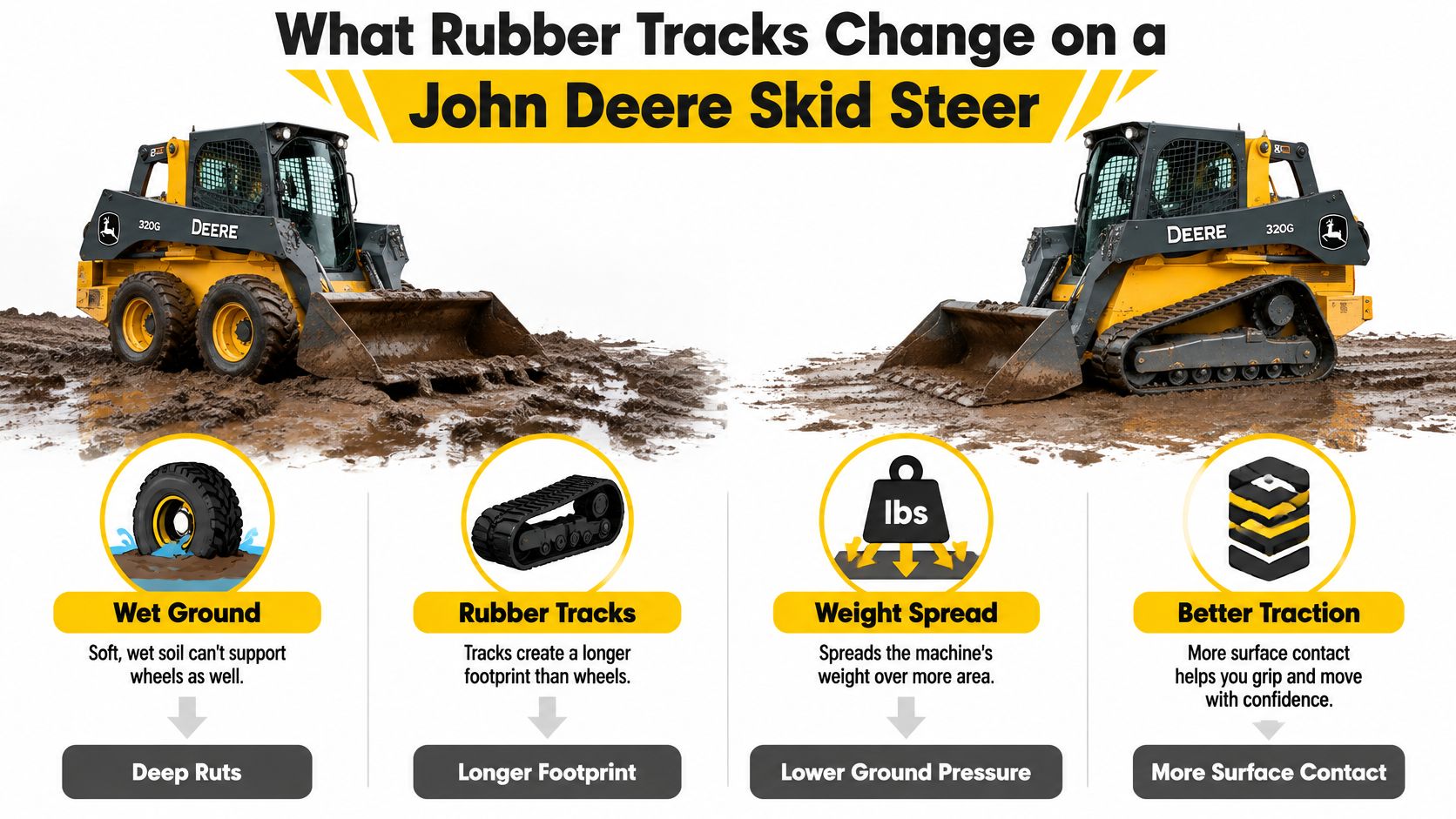
Parts You Will See
You'll hear half track used loosely for different setups.
Ignore the label and look at the system.
- Track belt: The rubber loop that contacts the ground and the rollers.
- Drive sprocket: The toothed wheel that engages the track and pulls it.
- Rollers: The bottom wheels that carry weight along the track frame.
- Idlers: The front and rear guides that keep the loop aligned.
- Tension system: The adjuster that holds the loop at the specified sag.
Deere's shift to dedicated tracked machines was deliberate. The John Deere Dubuque Works history records that Deere's dedicated compact track loader program began in 2005 with two models, marking a transition from primarily wheeled equipment toward rubber tracks for traction and reduced ground impact.
Deere's current compact track loader specifications in that history describe rated operating capacities ranging from 2,125 to 4,025 pounds across the broader lineup.
That spread is the buying lesson.
The track is one part of an undercarriage, so a replacement must match the sprocket, rollers, and frame it runs on. Brand alone doesn't do that.
Identify Your Machine Before You Shop for Tracks
The serial number matters more than the track size.
A model decal tells you the family.
It doesn't tell you which undercarriage options were fitted, which width the machine left the factory with, or which service spec applies.
Sellers who match on model alone are guessing with your money.
What to Gather First
Write these four items on one card before you open a catalog. Bring that card to any fitment call.
- Model designation: Copy it exactly from the machine decal.
- Serial number: Read it from the plate on the frame, not from memory or paperwork for a different machine.
- Machine configuration: Confirm whether the machine runs the standard track or an optional width.
- Existing measurements: Measure the old track or copy the spec from the operator's manual.
Park on level ground and clean the track first.
Measure width across the rubber from outer edge to outer edge, pitch between the centers of two adjacent drive lugs, and count every drive lug once around the loop for link count.
Record all three beside the serial number.
| Identifier | Where to find it | What it controls |
|---|---|---|
| Model designation | Decal on the machine and the operator's manual | Undercarriage family and service intervals |
| Serial number | Plate on the machine frame | Build configuration and option packages |
| Machine configuration | Operator's manual or dealer records | Standard versus optional track width |
| Track width, pitch and link count | Measure the existing track or read the manual spec | Ground contact, sprocket engagement and belt length |
| Tension specification | Maintenance section of the operator's manual | Correct sag for that specific model |
The operator's manual is the controlling source for specifications.
A catalog listing is only as reliable as the model and serial number it's matched against.
If a listing can't be tied to your serial configuration, treat it as unverified, no matter how confident the title sounds.
Once your card's complete, start with listings organized by machine, such as the John Deere track collection matched by model and dimensions, and filter by your recorded size.
Don't reverse the process by finding a price first and hoping it fits.
Track Width, Pitch and Link Count Explained
Three numbers describe a track, and each controls something different.
Get one wrong and the others don't rescue the order.
This illustration breaks the three measurements into the checks you'll make on the machine.
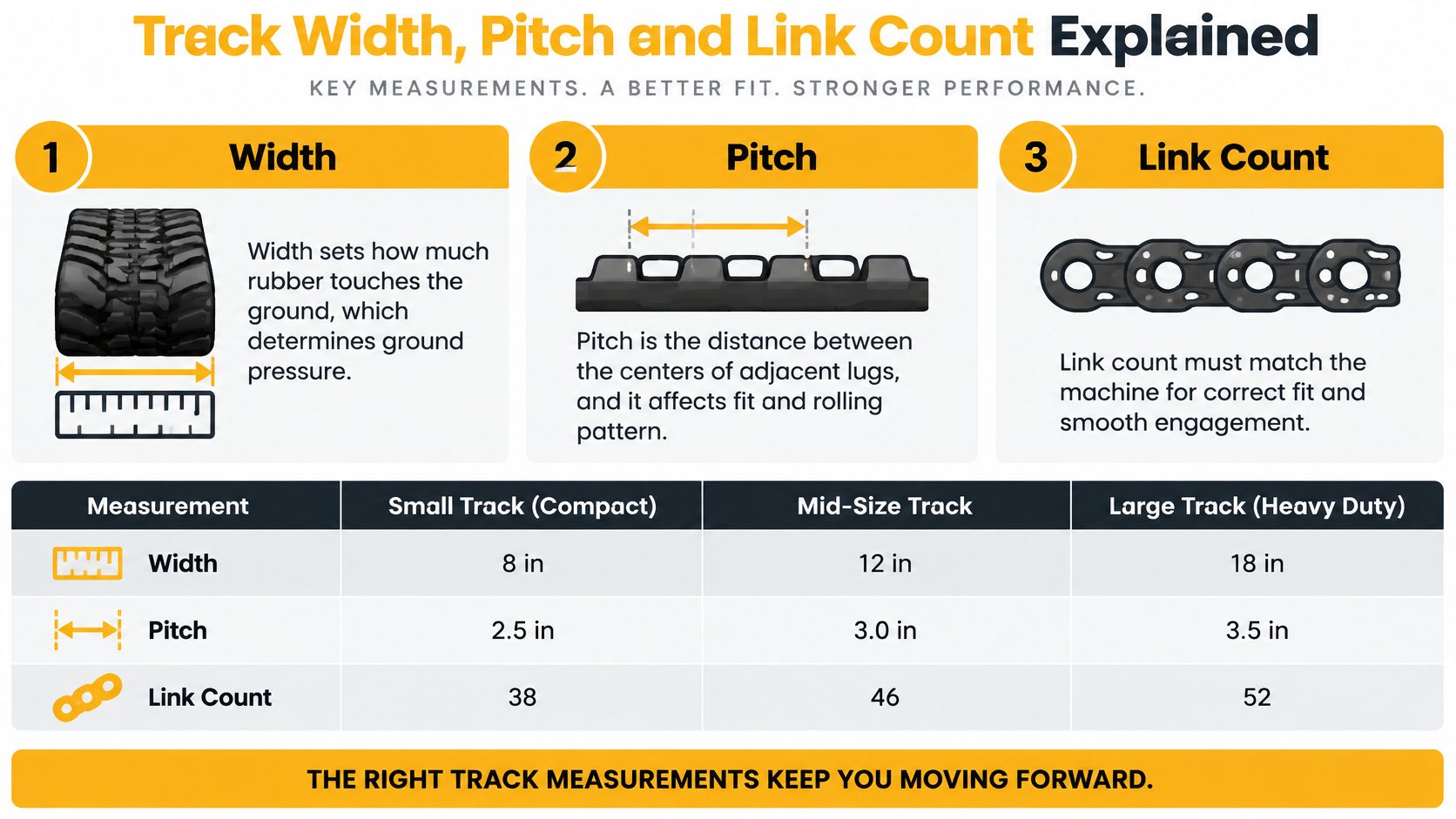
Width sets how much rubber touches the ground, which sets ground pressure.
Pitch is the spacing between adjacent drive lugs, like the spacing between chain links, and it must match the sprocket teeth so they seat cleanly instead of riding on lug edges.
Link count sets the total loop length, so one link too many or too few changes how the track tensions.
The width trade-off is measurable. The John Deere 333G compact track loader specification lists the standard 450 mm (17.7 in.) steel-insert rubber tracks at approximately 34.1 kPa (5.0 psi) ground pressure, while the optional 400 mm (15.8 in.) tracks increase pressure to about 38.4 kPa (5.6 psi).
Deere also specifies five triple-flange steel rollers and two double-flange idlers per side on that machine.
| 333G configuration | Track width | Ground pressure |
|---|---|---|
| Standard | 450 mm (17.7 in.) | 34.1 kPa (5.0 psi) |
| Optional | 400 mm (15.8 in.) | 38.4 kPa (5.6 psi) |
A narrower track can help you maneuver in tight areas.
On wet, weak ground, its smaller footprint sinks more and ruts sooner. Neither choice is wrong, but it's a choice about your ground, not a default.
Watch the measuring points in practice before you copy numbers to an order.
Use the written guide to measuring width, pitch and link count beside the machine, then compare all three figures to your serial configuration.
Nominal width alone is not enough.
Model Generations That Change Track Fitment
A series name narrows the search.
It doesn't settle it.
That's the surprise that catches buyers who order for a generation instead of for a specific machine, then discover the skid steer and compact track loader versions under that name run different undercarriages.
This timeline shows why the year helps, but can't finish the job.
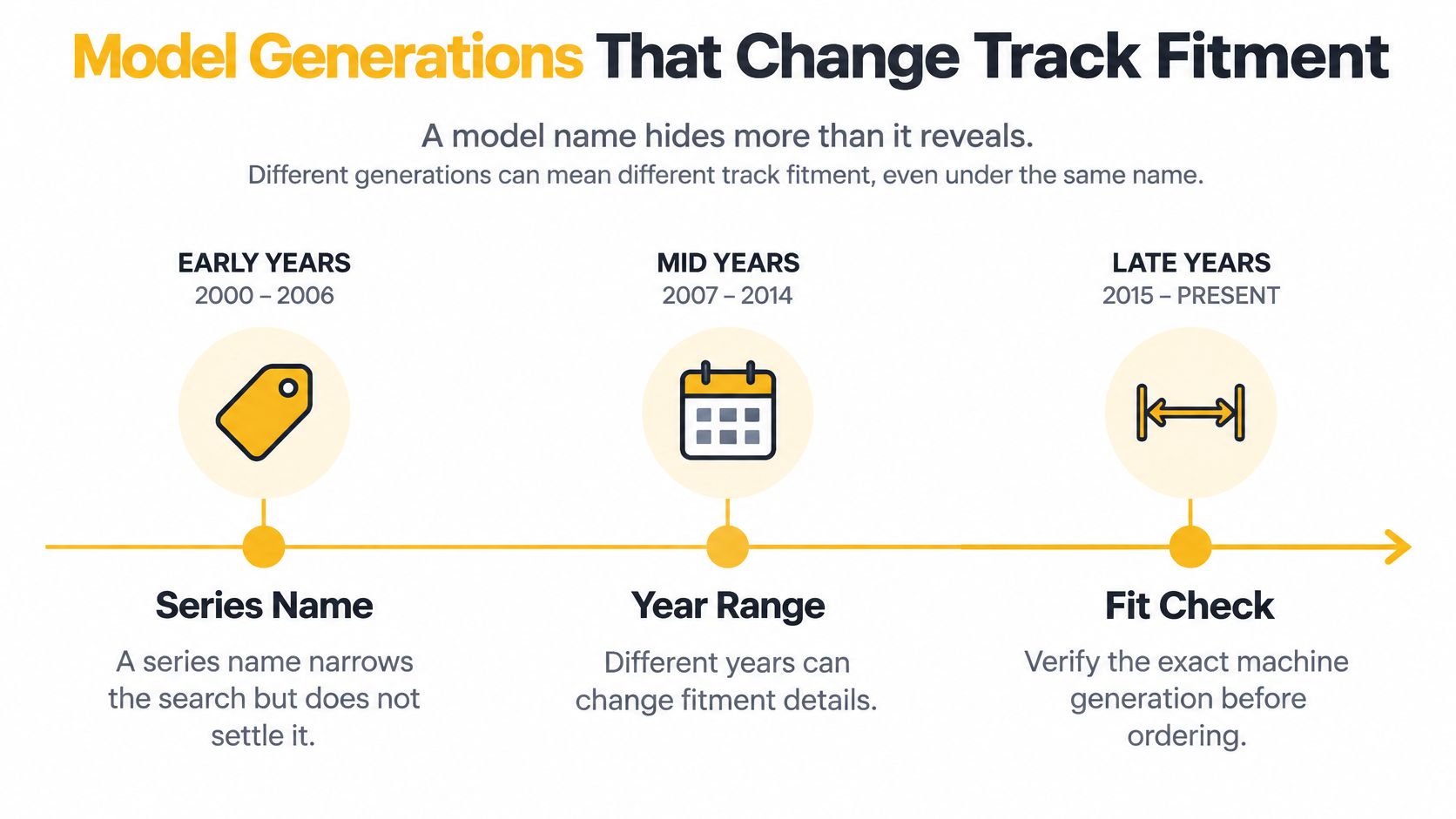
Say a buyer orders John Deere skid steer tracks by series name alone.
The pair arrives with a width that doesn't match, because the machine is a compact track loader version from the same generation with a different track configuration and roller layout.
The catalog wasn't lying. The identifier was incomplete.
Generations From 2004 Onward
The track-relevant split starts when one series covers both machine types.
The John Deere 50th anniversary skid steer history states the 300 Series, which included both skid steers and compact track loaders, was introduced in 2004, followed by the D-Series in 2009, E-Series in 2013, and G-Series beginning in 2016 for skid steers and 2018 for compact track loaders.
| Year | Model line | Machine type |
|---|---|---|
| 2004 | 300 Series | Skid steers and compact track loaders |
| 2005 | Compact track loader program (two models) | Compact track loaders |
| 2009 | D-Series | Confirm type by serial number |
| 2013 | E-Series | Confirm type by serial number |
| 2016 | G-Series | Skid steers |
| 2018 | G-Series | Compact track loaders |
| 2021 | 333G Compact Track Loader (SmartGrade) | Compact track loaders |
| 2024 | P-Tier 330, 331, 333, 334, 335 | Skid steers and compact track loaders |
Watch the dates, too. The 300 Series appears as 2004 in Deere's product history and within the 2005 period in the Dubuque Works record, so confirm build year against the serial configuration rather than a brochure date.
Year and series narrow the search.
The serial number closes it.
Tension and Undercarriage Checks Before Installing
A track can be the right size and still fail early because the undercarriage under it is worn.
New rubber on hooked sprocket teeth or flat-spotted rollers doesn't get a fair chance. Inspect first, then install.
Inspect Before You Mount
Clean packed mud and rock out of the roller path so you can see the parts.
Spin rollers and idlers by hand where you can, look for flat spots and damaged flanges, and check for fluid leaking from seals.
Run your eye along sprocket teeth for hooked, pointed tips, which grab at the track instead of seating cleanly.
| Component | What to check | Risk if ignored |
|---|---|---|
| Drive sprocket | Hooked or worn tooth tips | Track slips and wears faster |
| Rollers and idlers | Flat spots, damaged flanges, fluid leaks | Track runs off center or derails |
| Track tension | Sag measured to the manual specification | Over-tight parts wear; loose track can de-track |
| Debris buildup | Packed mud or rock in the roller path | Accelerated roller and track wear |
Set Tension by Measurement
Don't trust a track that only looks tight.
The John Deere rubber tracks guide states CTL track adjustment is accessible with basic hand tools and a grease gun, while the operator's manual remains the controlling source for the correct sag measurement.
It warns excessive tension accelerates component wear, while insufficient tension can allow de-tracking, and recommends checking track sag weekly or as needed because rubber tracks gradually lose tension in service.
Deere also claims its newer track design extends roller-path life by up to 22% versus the prior version. Treat that as a manufacturer claim, not a guarantee for your ground and habits.
Design improvements don't survive packed debris and wrong tension.
If you're weighing worn components against a new pair, this background on evaluating used skid loader tracks and undercarriage wear helps you judge what's still serviceable.
Follow the sequence every time. Inspect, clean, install, then set tension to the model specification by measurement.
Misconceptions and the Order Checklist
Most wrong orders come from beliefs that sound reasonable.
It's like buying a shoe by length alone and ignoring width, arch, and how worn your old pair is.
The shoe goes on. It still hurts by noon.
This summary pulls the selection factors together before you correct the habits behind bad orders.
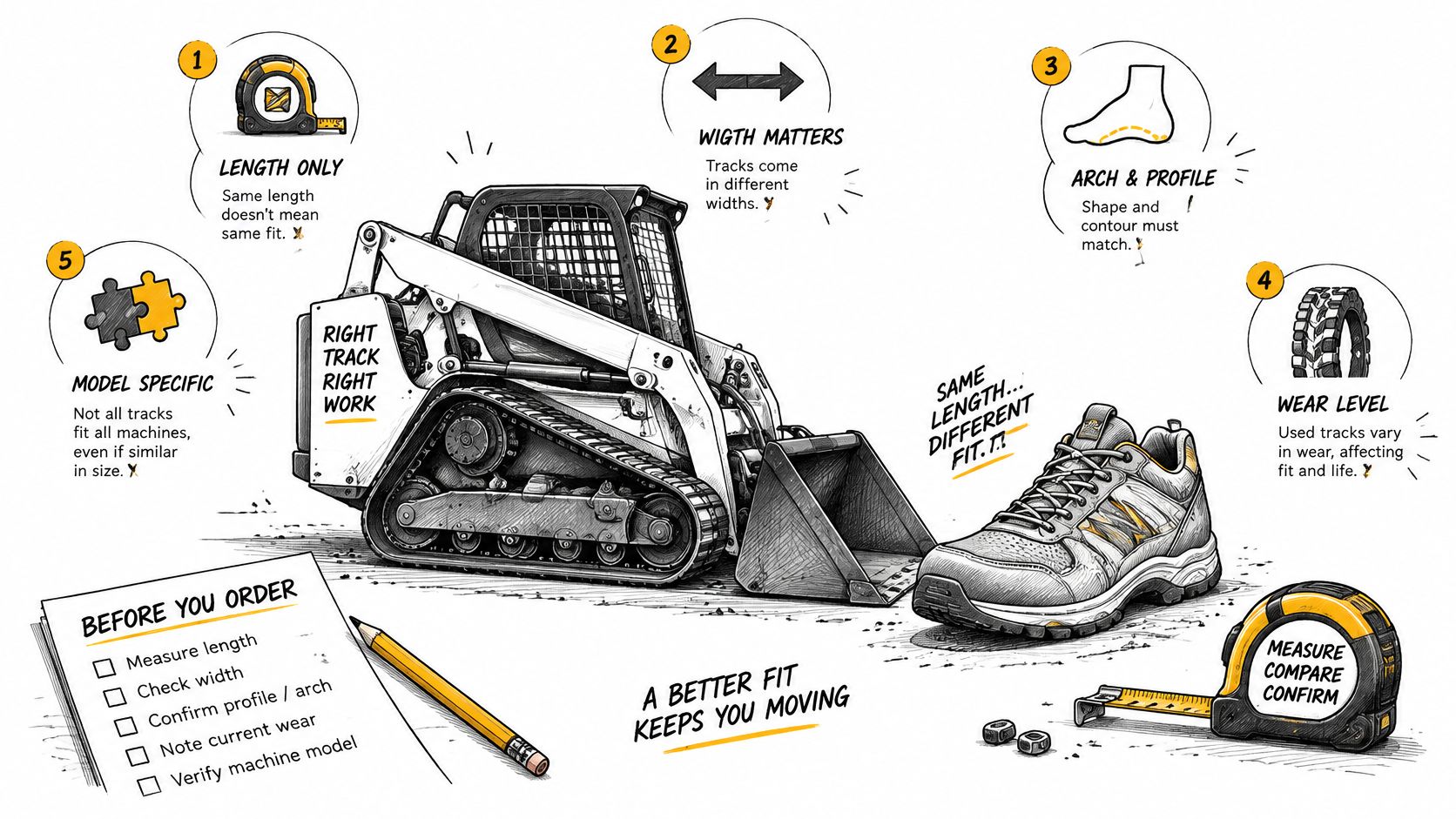
Five Beliefs That Cause Misorders
- Same width means same track: It doesn't. Pitch decides whether the sprocket seats, and link count decides whether the loop tensions correctly.
- The brand is enough: John Deere covers many generations and configurations. Your serial number identifies the one in your yard.
- A visibly tight track is tensioned: Eyes can't measure sag. Use the manual specification for your model and a grease gun adjustment to match it.
- A new track fixes worn sprockets: It won't. Hooked teeth keep chewing, and the new belt wears into the old pattern fast.
- If it fits, it will last: Fit gets it mounted. Undercarriage condition, tension, debris control, and your ground decide service life.
Practical rule:
Separate two questions.
Will it install, and will it deliver acceptable service life on this undercarriage.
You need yes to both.
The Five Step Order Checklist
- Confirm identity: Match the model designation and serial number on the machine against the operator's manual.
- Confirm dimensions: Compare width, pitch, and link count with that serial configuration, not with nominal width from a listing title.
- Inspect and clean: Check sprockets, rollers, and idlers for hooks, flat spots, flange damage, and leaks. Clear the roller path.
- Plan tensioning: Find the sag specification and adjustment procedure for your exact model before the tracks arrive.
- Order as a pair: Keep the serial number written on the order so any fitment question traces back to the machine.
Pair pricing makes the math plain.
For example, our John Deere 325G Rubber Track 400x86x52 is listed at $1,379.00 for a pair, and we offer a 30 month warranty on our tracks covering defects in materials and workmanship.
Use that format when you compare quotes.
Per-track prices that look cheaper often aren't.
I would not release an order until one check is written down and verified.
Serial-matched width, pitch, and link count, all three, on the order itself.
If any number came from memory, a previous owner's note, or a listing for a similar model, stop and remeasure.
Ten minutes with a tape and the serial plate costs less than freight on the wrong pair and another week of downtime.
Bring your model, serial number, and measured width, pitch, and link count to DirtPusher, where we sell aftermarket rubber tracks as matched pairs for John Deere skid steers and compact track loaders. Use the model listings and measurement resources to confirm fit before you check out, then order the pair your undercarriage can support.