

Your loader is parked with a damaged track, tomorrow's work is booked, and a used pair in a listing looks good enough to get you moving. The tread looks substantial, the price is tempting, and the seller says there's plenty of life left.
That's when used skid loader tracks need more scrutiny, not less. A cheap track can leave you paying for installation twice, losing working time, and repairing undercarriage components that should've been checked before purchase. Buy on measurable condition and fitment, not photographs or an hour-meter reading.
Table of Contents
- Where to Find Used Tracks and When Buying Used Makes Sense
- Track Condition Thresholds Worth Checking
- How to Inspect Used Skid Steer Tracks Step by Step
- Estimating Remaining Life Before You Pay
- The Hidden Dangers of Buying Used Tracks
- Why Replacing the Full Pair With New Tracks Pays Off
- When a Used Track Set Still Makes Sense
- Confirm Your Track Size and Order a New Pair
Where to Find Used Tracks and When Buying Used Makes Sense
You're looking at a listing photo, but the important surfaces may be underneath the track or facing the machine. Before arranging collection, establish where the tracks came from, whether you can inspect both loops, and what happens if they aren't as described.
Used tracks turn up through several channels:
- Dealer used-equipment lots: Ask whether they're takeoffs from a trade-in and whether the dealer will document condition and return terms.
- Auction houses: Check inspection access, buyer fees, collection requirements, and as-is terms before bidding.
- Rental-fleet disposals: Request the machine identification and maintenance records associated with the tracks.
- Equipment-finance resale listings: Establish who possesses the equipment and who can authorize an operational inspection.
- Private sellers: Ask why the tracks were removed. A direct account is useful, but it isn't a substitute for records.
The Eddisons used-equipment buying guide recommends physical inspection because online purchases can conceal defects, and notes that used equipment commonly carries reduced warranty protection or none at all. For tracks, a clean photograph can still hide inner drive-lug damage, embedded debris, and cuts beneath packed dirt.
When the compromise is reasonable
Used can make sense for an emergency repair, a short remaining ownership period, or a temporary machine with limited duties. Selling soon doesn't justify concealing a defect, though. Disclose the condition and keep the inspection paperwork.
Before visiting, ask for service history, storage conditions, size markings, and written sale terms. Refused inspection, unexplained outdoor storage, missing history, or a price far below comparable pairs should stop the purchase until the seller resolves the concern.
Buying rule: If you can't measure and inspect both tracks yourself, treat the listing as unpriced risk, not a bargain.
Track Condition Thresholds Worth Checking
Start with a depth gauge, a flashlight, and a screening sheet. Fortis HD's track-maintenance guidance recommends replacement when lug height falls below 5 mm (0.2 in) and calls for prompt replacement when larger tears expose reinforcement cables.
That's a screening threshold, not permission to buy every track above it. A track can have usable tread and still fail because its reinforcement, drive lugs, or rubber structure is damaged. Apply the machine and track manufacturer's replacement criteria whenever they're stricter.
Used track condition thresholds
| Check | How to inspect | Replace or reject when |
|---|---|---|
| Lug height | Measure at several points on each track and compare sides | Below the published minimum stated above |
| Exposed reinforcement | Look along tears and cuts for exposed cords | Any exposed cord |
| Missing or damaged lugs | Count and inspect every drive lug around the loop | Any missing or broken drive lugs |
| Uneven wear | Compare left and right tracks and check across the width | One side or edge clearly more worn |
| Cracking and hardening | Check sidewalls, tread base, and areas around embedded steel | Fine crack networks, brittle rubber, or cuts that deepen |
| Tension and lug skipping | Check tension and watch the track under load | Ratcheting, skipping, or tension that cannot be held |
| Sprocket and roller wear | Inspect drive sprocket teeth, idlers, and rollers | Flat spots or worn teeth, fix before fitting any track |
Measure from the tread base to the lug face, avoiding packed material and torn edges. Record readings around each loop, including the visibly weakest areas. The best-looking lug doesn't represent the whole track.
Outer tread lugs and inner drive lugs do different jobs. Outer lugs provide ground engagement; inner lugs must engage the drive system reliably. Substantial outer tread doesn't compensate for broken drive lugs.
Distinguish surface marks from structural damage
A shallow surface mark isn't automatically a failed track. Clean it, inspect its base, and look for separation, brittleness, reinforcement exposure, or a crack that opens as the rubber flexes during normal movement. Don't cut into the rubber to investigate it.
Uneven wear deserves particular attention because it may identify a machine problem rather than an isolated track defect. A replacement track won't straighten a misaligned undercarriage or restore a worn roller.
Treat the table as a conservative purchase screen. If a track fails a row, reject it rather than negotiate around the defect. If the undercarriage fails, stop installation until the cause is corrected.
How to Inspect Used Skid Steer Tracks Step by Step
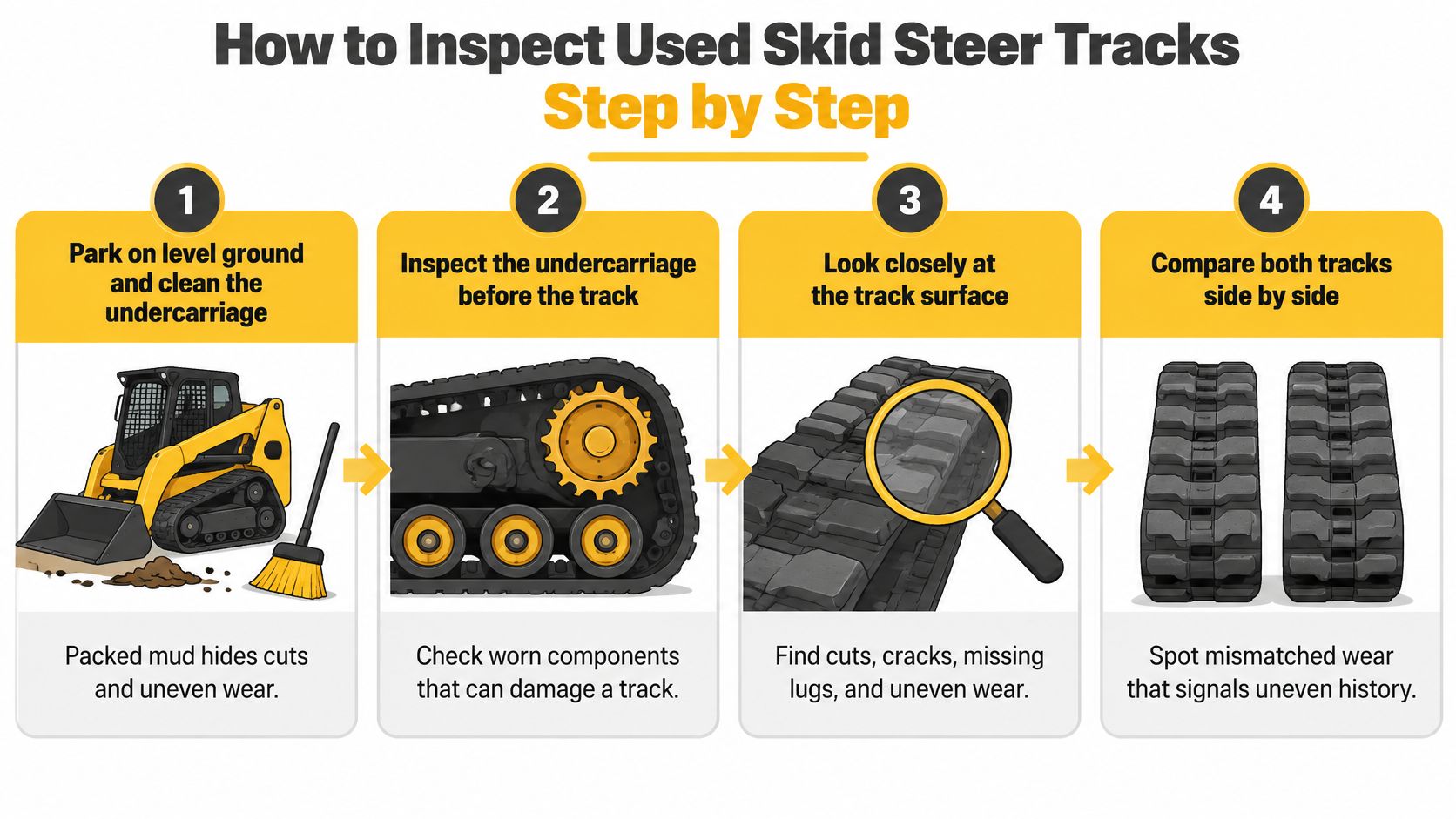
Inspect the machine before committing to the loose parts. The Bridgestone rubber-track operating manual recommends periodic checks of the drive wheel, mid-rollers, and idler because component wear and damaged rubberized surfaces affect track performance and durability.
Carry out the inspection safely
- Park and clean. Choose level ground, lower the attachment, shut down, and follow the machine's isolation procedure before approaching the undercarriage. Remove packed mud so it can't conceal cuts or prevent you from seeing roller surfaces.
- Inspect the undercarriage first. Examine sprocket teeth, idlers, roller surfaces, seals, and mounting hardware for wear, damage, and leakage. Worn components change how the track carries load, so sound-looking rubber alone isn't enough.
- Measure and compare. Use a tread-depth gauge or caliper at several positions around each track, then record the lowest readings. Compare corresponding areas on the opposite side rather than averaging away a badly worn section.
- Examine the complete loop. Inspect the outside, sidewalls, inner drive lugs, and accessible reinforcement areas for cuts, cracking, missing material, and embedded debris. Have the operator reposition the machine between inspections, then shut it down again before approaching.
- Check tension and adjuster travel. Use the model-specific measurement position and procedure, including approved support equipment if lifting is required. Confirm that the adjuster has usable travel rather than sitting near its limit.
- Test forward, reverse, and turning. Have a competent operator travel in a clear area and make controlled tight turns permitted by the operating manual. Observe from outside the travel path and listen for ratcheting, impacts, or irregular engagement under an appropriate working load.
- Document what you're buying. Record the machine serial number, track markings, indicated hours, reported track-installation history, and storage conditions. Put the seller's service statements, warranty, and return terms in writing before payment.
- Make the decision. Proceed only when the tracks clear the inspection with useful margin and fitment is established. Otherwise, walk away or include a complete replacement pair and necessary undercarriage repairs in the machine purchase budget.
Don't substitute adjustment for diagnosis
The Camso installation and operating guidelines explain that loose tracks can derail and misfeed, while excessive tension increases undercarriage loads and accelerates failure. Tightening a track until the noise disappears isn't a sound repair.
A parked photograph can't show engagement under load. For tracks still installed on a machine, the turning and reverse test is part of the buying decision, not an optional demonstration.
Estimating Remaining Life Before You Pay
You can estimate tread wear, but you can't reliably convert tread depth into a guaranteed retirement date. Equipment World's maintenance discussion describes rubber-track life expectations of approximately 1,200–1,600 operating hours, while emphasizing how operation and working conditions affect wear.
Don't treat that range as a ceiling, a promise, or a balance you can subtract from the hour meter. The tracks may have been replaced during the machine's life, and structural damage can end their service before the tread wears out.
Build a defensible wear estimate
Find the original lug height for the exact track design from its specification or an unworn equivalent. Compare that with the lowest current measurements, not just an average.
Use these relationships:
- Tread fraction remaining: Current lug height divided by original lug height.
- Observed wear rate: Lug height lost divided by documented hours on those tracks.
- Projected working time: Usable lug height above the applicable replacement limit divided by observed wear rate.
Use the stricter applicable manufacturer or maintenance replacement criterion. Don't project wear all the way to a smooth track, and don't calculate a positive remaining life for rubber that already fails the structural inspection.
A wear-rate calculation is useful only when you know the tracks' installation history and expect comparable future work.
A machine meter alone doesn't provide track hours. If the seller can't establish when the tracks were fitted, record remaining tread without inventing an hourly forecast.
Finish with a purchase worksheet: acquisition cost, installation, immediate undercarriage repairs, likely interruption to work, and a replacement allowance. Aggressive spinning, counter-rotation, abrasive surfaces, or a move into harder work justify a more conservative allowance, not an optimistic extension of the seller's estimate.
The Hidden Dangers of Buying Used Tracks
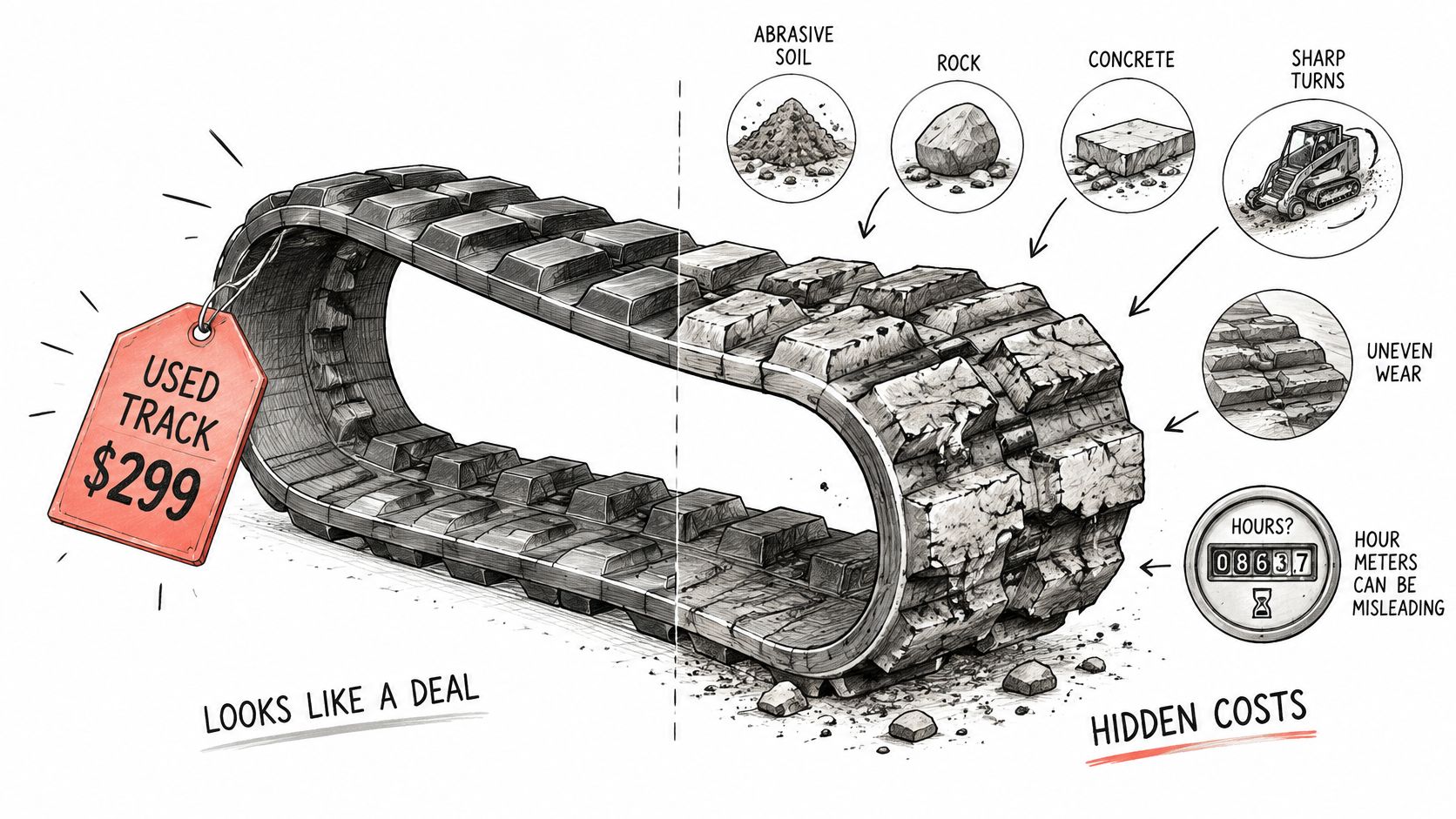
The hour meter doesn't tell you whether the machine graded soil or pivoted through demolition debris. Similar indicated hours can conceal very different track condition, particularly when several operators shared the machine.
Rental provenance deserves questions rather than automatic rejection. Equipment World's rental-market reporting puts U.S. rental penetration at 57% in 2024, making fleet history a relevant consideration when evaluating used equipment.
Ask what the machine actually did
A high-hour fleet machine with documented maintenance can be a better candidate than a low-hour private machine operated aggressively. The useful distinction is documented care versus unknown treatment, not rental versus private ownership.
Request evidence that helps explain the wear:
- Service invoices: Track installation dates, tension adjustments, and undercarriage repairs.
- Rental or work records: Applications, jobsite conditions, and reported damage.
- Telematics records: Available operating information that helps reconcile the stated history.
- Attachment history: Whether the machine carried grading equipment or worked around sharp demolition material.
Severe grouser wear paired with claimed light use needs an explanation. So does a recently replaced track running beside a heavily worn partner.
Price the failure chain
Illustrative scenario: A buyer accepts a discounted used pair, installs it, and returns to work. A track then fails before the next scheduled job, leaving the buyer with another purchase, repeat installation labor, transport arrangements, and an idle machine.
If the original problem included incorrect fitment or damaged undercarriage components, the new bill may extend beyond rubber. Meanwhile, the seller's written terms may offer no practical recovery.
For a contractor, lost machine time can also mean rescheduling an operator, hired attachment, or material delivery. Include those obligations when comparing prices rather than assuming downtime costs nothing because you own the loader.
The discount is compensation for uncertainty you accept. If the seller can't resolve that uncertainty with inspection, records, and clear terms, the price needs to reflect a potential immediate replacement.
Why Replacing the Full Pair With New Tracks Pays Off
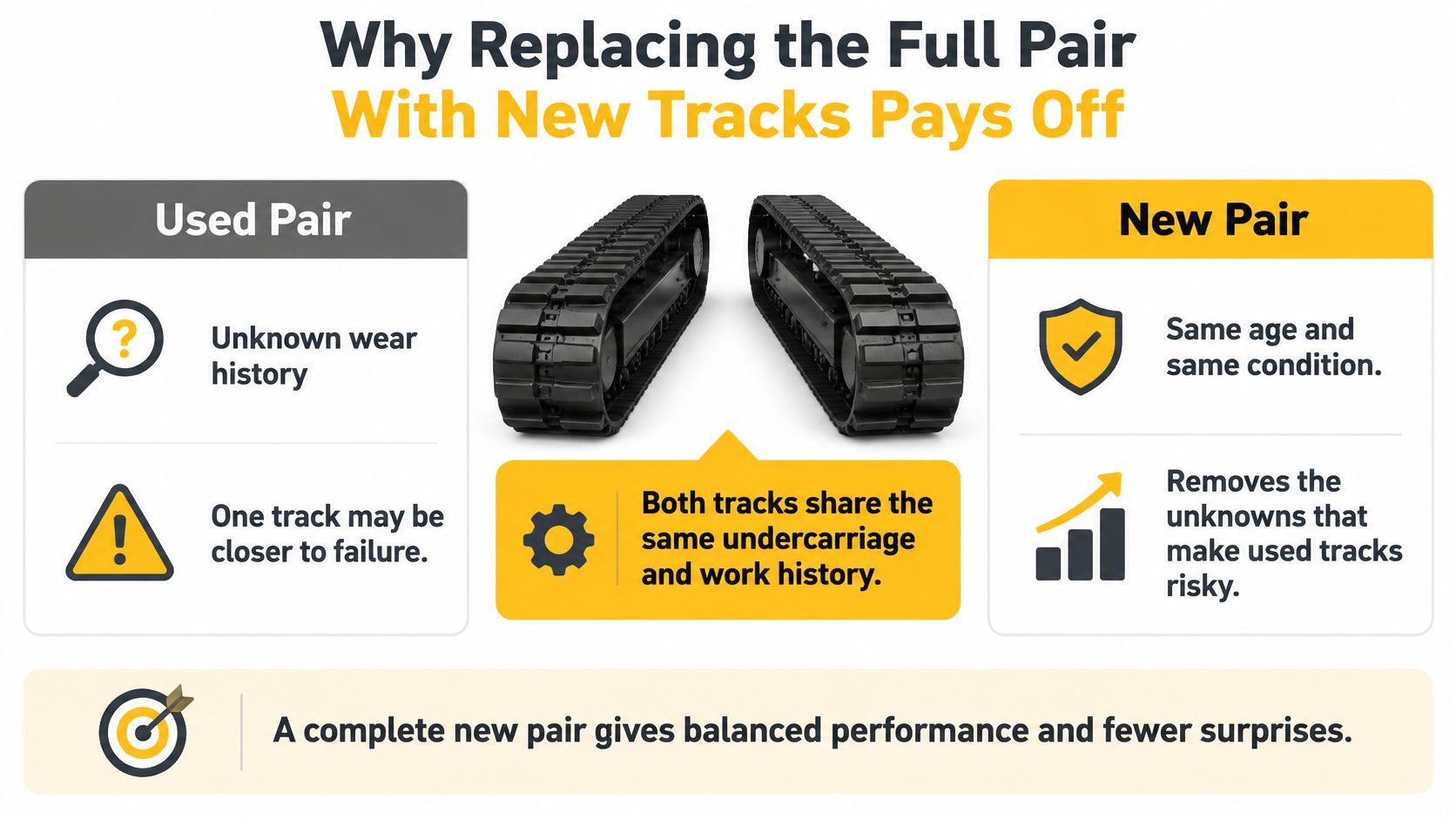
Both tracks work on the same machine, but they don't necessarily have identical remaining life. One side may have experienced different loading, damage, or replacement history. Buying a used pair without comparing both loops can leave you scheduling another repair almost immediately.
A complete new pair establishes a common starting point for tread, rubber condition, and maintenance records. That's particularly useful when you depend on the loader for booked work rather than occasional property maintenance.
Used pair versus new pair
| Factor | Used Pair | New Pair |
|---|---|---|
| Warranty | Often reduced or none; confirm terms in writing | Written coverage against materials and workmanship defects where offered |
| Remaining tread | Unknown until measured on both tracks | Full original lug height |
| Service history | Often incomplete or unverified | Known starting condition |
| Undercarriage risk | May carry wear from damaged sprockets and rollers | Still requires inspection; track starts unworn |
| Risk of early failure | Hidden damage can require another replacement | Less uncertainty about prior wear |
| Upfront price | Usually lower | Usually higher |
| Downtime exposure | Difficult to plan when remaining condition is uncertain | Easier to manage from a known starting point |
Warranty matters because it defines a route for addressing a covered defect. It doesn't mean every failure is covered, and it doesn't replace correct installation or maintenance. Read exclusions, claim requirements, and evidence requirements before buying.
Tread depth doesn't reveal rubber age
McLaren's track-inspection guidance warns about environmental cracking and recommends covered or shaded storage. A used track with substantial tread can still have brittle rubber, separation, or hidden reinforcement fatigue.
That uncertainty is why I would choose new for a production machine when the used set has incomplete records or marginal condition. Compare the delivered, installed cost of a replacement track pair with the used purchase plus the realistic cost of an early interruption.
A new pair won't cure worn sprockets, seized rollers, or bad alignment. Correct those problems first, verify sizing, and set tension to the machine specification.
Choose new when the used tread is close to its replacement limit, wear is uneven, reinforcement is exposed, or the seller can't establish condition. The practical benefit isn't an assurance that nothing can fail. It's removing avoidable uncertainty before the machine goes back to work.
When a Used Track Set Still Makes Sense
Used isn't automatically the wrong choice. It can be reasonable for a short job on softer ground, a temporary backup machine, or equipment nearing a planned sale, provided the tracks are serviceable.
The decision requires several conditions to be true together:
- Inspection passes: Both loops clear the condition checks with useful margin.
- The machine is healthy: Undercarriage inspection finds no unresolved problem likely to damage the tracks.
- Testing supports the sale: Engagement remains stable through forward travel, reverse, and controlled turning.
- The paperwork matches: Service history, storage information, fitment, and sale terms are documented.
Fleet records showing track-position changes and undercarriage replacements can support a purchase. A seller's verbal assurance that maintenance was always done can't carry the same weight.
Match the compromise to the work
Light-duty use still needs suitable tread. If winter work is the reason for buying, use our guide to skid steer tracks for snow to assess the application rather than assuming any remaining tread will provide adequate grip.
After purchase, establish correct tension, wash the machine after use, and brief every operator to avoid unnecessary spinning and counter-rotation. Keep the inspection record with the machine so the next check has a baseline.
Confirm each buying condition in writing before paying. If a required condition remains unresolved, budget for full replacement instead of calling the uncertainty a saving.
Confirm Your Track Size and Order a New Pair
Once you've decided to replace, fitment comes before checkout. A track that looks similar isn't necessarily compatible with the machine's drive system or clearance.
Measure the existing track
Read the molded size marking and confirm it against physical measurements. For 400x86x53, the figures identify a 400 mm width, 86 mm pitch, and 53 links around the loop.
Measure pitch between corresponding points on adjacent drive elements, not the gap between their edges. Mark a starting link before counting so you don't lose your place, and use our rubber-track measurement guide to check the method.
Match the machine and confirm the pair
Record the make, model, and serial number, then compare them with the track marking and measured dimensions. Don't assume the existing track is correct merely because it's installed.
At DirtPusher, we sell high-quality aftermarket rubber tracks for skid steers, compact track loaders, and mini excavators, including Bobcat, Cat, Kubota, John Deere, Takeuchi, and Case machines. Our pair-based listings make clear that the order includes both tracks.
Send us the machine identification and track measurements by phone or text before ordering if fitment is uncertain. We offer a 12-month warranty against defects in materials and workmanship; confirm the current terms and claim requirements with us before purchase.
Order with installation in mind
Replace both sides together when both are worn so you establish a matched maintenance baseline. Arrange an undercarriage inspection before installation, rather than discovering damaged components after the tracks arrive.
The sequence is straightforward: measure, match, confirm the pair, and order. Then correct undercarriage defects and have the tracks installed and tensioned using the machine-specific procedure.
DirtPusher offers aftermarket rubber track pairs and fitment assistance for owners replacing worn or questionable used tracks. Visit DirtPusher with your machine's make, model, serial number, and track measurements to confirm a suitable pair before you order.