

Track width is the center-to-center distance between the left and right tracks, measured across the machine at the same point, and it's also called track gauge on tracked machines. If that sounds straightforward, why do so many spec sheets leave owner-operators holding the wrong number for an order?
Most mistakes don't start with a bad tape measure. They start when someone quotes one width, a supplier hears another, and nobody names which measurement they meant.
Table of Contents
- Track Width Defined in Plain Terms
- The Three Widths People Mix Up
- How to Measure Track Width on Your Machine
- Reading the Track Size Code Beside the Width
- Why Wider Tracks Are Not Always Better
- Misconceptions and the Pre-Order Check
Track Width Defined in Plain Terms
Track width is the distance from the center of one track to the center of the other, measured across the machine at the same point. Think about your own stance. Stand with your feet apart and your balance depends on the distance between the centers of your feet, not the distance from the outside of one boot to the outside of the other.
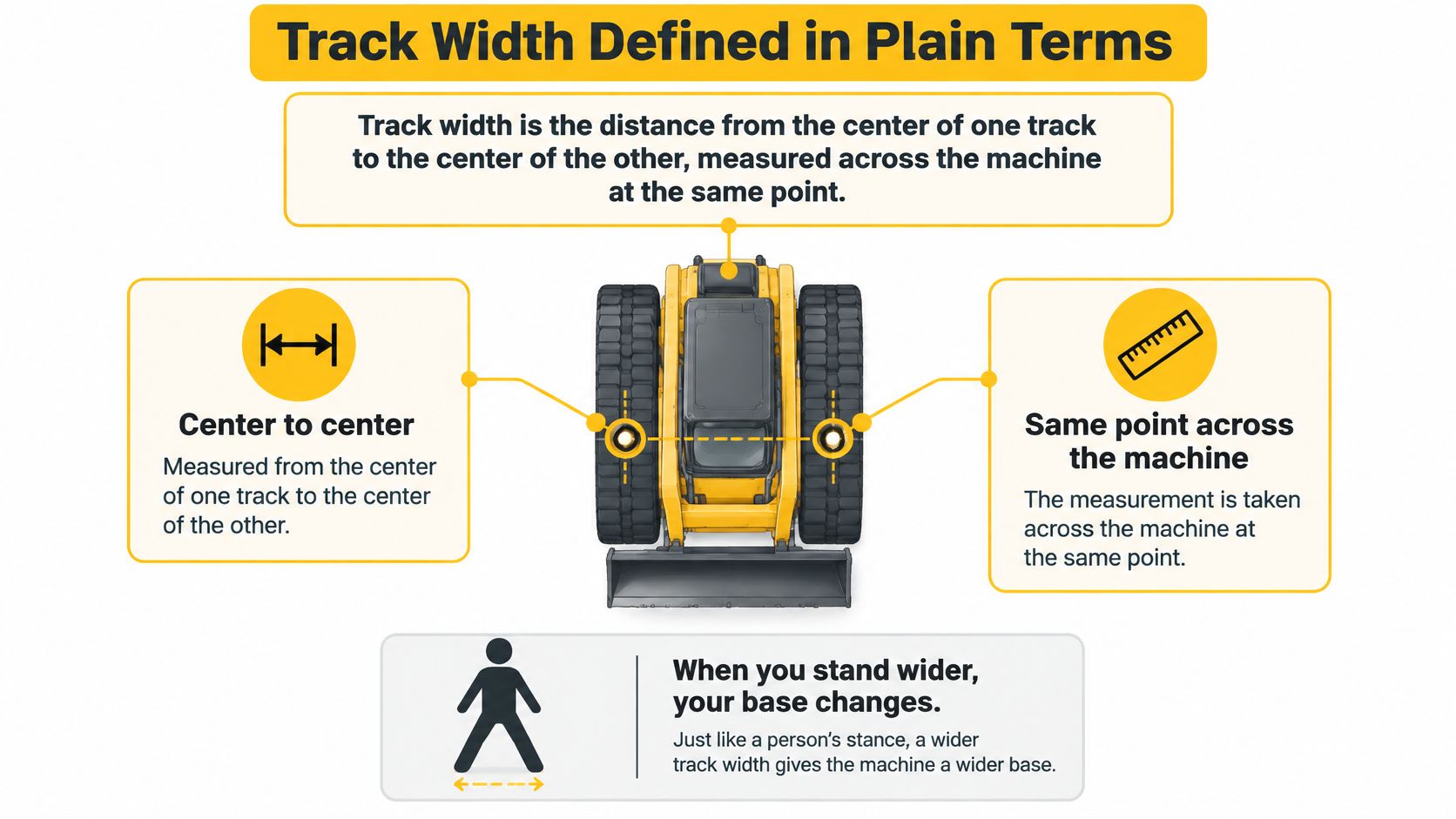
That stance idea is the same one used for wheeled machines. The National Institute of Standards and Technology definition describes track width as the distance between the center points of the tires on opposite sides of the same axle, such as from the center of the right front tire to the center of the left front tire.
Why the Center Matters
Centers are stable reference points. Tire rubber, track rubber, fenders, and body panels can vary or stick out farther, but the center of each track assembly tells you how the undercarriage is spaced. That's why What is track width remains a geometry question first, not a shopping question.
On a skid steer with tracks, a compact track loader, or a mini excavator, you'll usually see this dimension labeled track gauge. That term means the center-to-center spacing between the left and right track assemblies, and it's the number engineers use for machine geometry and undercarriage fit.
Working distinction: Track gauge spaces the two tracks on the machine. Belt width measures one track on its own.
Don't treat those as the same number. A track shoe or rubber belt has its own width, and that width belongs to a replacement part, not to the machine's stance. When you open a spec sheet, find the gauge figure and write track gauge, center to center beside it so nobody later mistakes it for a track size.
The Three Widths People Mix Up
Ask for a machine's track width and you can get three different numbers, all of them correct, because one machine carries three widths. Belt or shoe width is the width of a single rubber track or steel shoe. Track gauge is the center-to-center spacing between the left and right tracks. Overall machine width is the whole machine edge to edge, attachments in travel position included. Shoe size, stance, and shoulders with a loaded pack: all real widths of the same person, and none of them interchangeable.
| Measurement | What It Measures | Caterpillar 973D Example | Why It Matters |
|---|---|---|---|
| Belt or shoe width | Width of one rubber track or steel shoe | 550 mm (21.6 in) standard; 675 mm (26.6 in) optional | Sets the replacement track width |
| Track gauge (track width) | Center-to-center spacing between left and right tracks | 2,160 mm (85 in) | Sets machine geometry and undercarriage fit |
| Overall machine width | Outside edge to outside edge, including attachments | 2,710 mm (106.7 in) with the 550 mm shoe, calculated as gauge plus one shoe width | Sets trailer, gate and road clearance |
The Caterpillar example shows why mixing up the first two rows causes trouble. The Caterpillar 973D track loader specification lists a standard track shoe width of 550 millimeters (21.6 inches), an optional shoe width of 675 millimeters (26.6 inches), and a 2,160-millimeter (85-inch) track gauge.
You can't quote 550 mm or 675 mm as the machine's track-to-track width. Those numbers describe one shoe. The 2,160 mm figure describes the spacing between the two track centers, a completely different dimension.
The outside-edge trap works the same way. Stretch a tape across the 973D at its widest point and you read 2,710 mm, the 2,160 mm gauge plus one full 550 mm shoe. The figure is real, repeatable, and wrong for fitment: it describes the machine's shipping envelope while the supplier asked about undercarriage spacing. That is why the number buyers reach for first so often answers a question nobody asked.
Where Overall Width Decides the Job
Overall width is the transport number. Road authorities set width limits for ordinary loads, and a machine past the limit travels as an abnormal load with permits, escorts, or restricted routes. A gauge figure can't tell you where your machine sits against those rules, which is why the third row of the table exists.
Use this rule on every call and quote. Name the measurement before you give the number. Say belt width, gauge, or overall width first, then the figure, and you've removed the most common source of a wrong order.
How to Measure Track Width on Your Machine
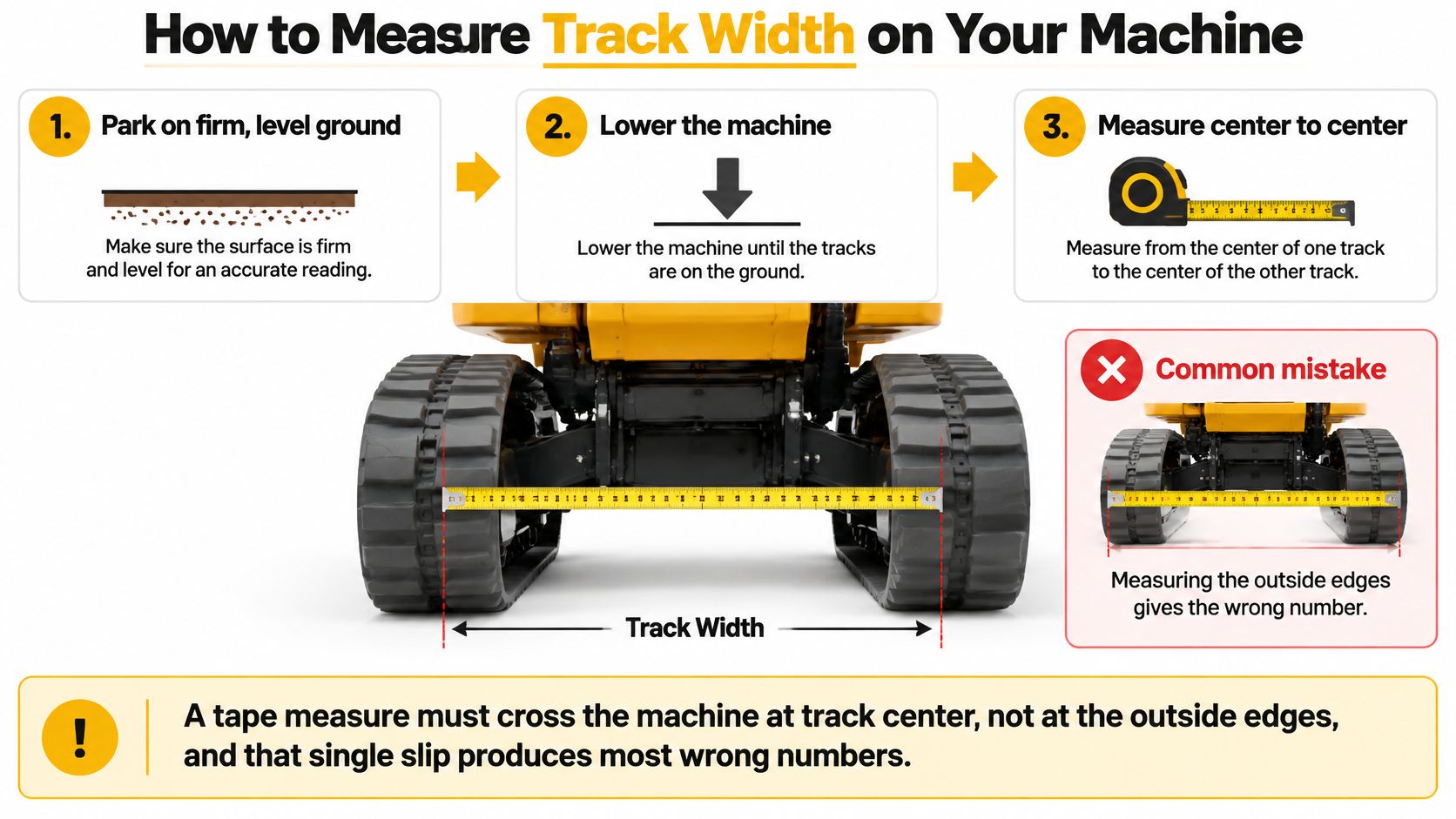
Your tape has to cross the machine at track center, not at the outside edges. That single slip produces most wrong numbers, because an outside-edge reading looks plausible while measuring something your supplier can't use as track width.
Steps for a Usable Reading
- Park safely: Stop on firm, level ground, lower the attachment, and switch the engine off. Soft or sloped ground lets the machine shift and makes a straight cross-machine reading harder to repeat.
- Pick the same point on both sides: Find the center of the left track at the front idler and the center of the right track at the same point. Measuring one side at the front and the other farther back creates a diagonal, not track width.
- Measure straight across: Run the tape between those centers and keep it square to the tracks. If the tape angles or sags, you'll record a number that's longer than the actual gauge.
- Repeat at the rear idler: Take the same center-to-center reading at the back. If front and rear don't match, write both down and check the manual instead of averaging them.
- Measure one belt separately: Lay the tape across a single track from edge to edge to get belt width. Don't pull this number from your gauge reading, since they're different measurements.
- Read the molded size: Look for the size molded on the inside of your current track, which lists width, pitch, and link count. A worn or dirty inner surface may need cleaning before you can read it.
- Measure overall width last: With attachments in travel position, measure outside edge to outside edge. This is your gate and trailer figure, not your track width.
Measuring outside edge to outside edge gives you a clearance number. It does not give you track gauge, and it won't size a replacement track.
Say you measure outside to outside and get a tidy figure. That number includes half a belt on each side beyond the centers, so it's wider than gauge by one full belt width. It'll sound right on the phone, but it's unusable for confirming undercarriage spacing.
Finish with three labeled, dated numbers on paper before you shop. That record is what you need when you review sizing for compact track loader tracks, and it keeps every conversation anchored to the same measurements.
Reading the Track Size Code Beside the Width
Replacement tracks carry a three-number code, and only the first number is a width. A track size such as 450x86x56 means a 450 mm wide track with an 86 mm pitch and 56 links. Those three numbers describe the belt itself, not how far apart the two belts sit on your machine.
Think of a staircase. Width is how wide each step is across. Pitch is the distance from one step's center to the next, measured either in millimeters as the gap between link centers. Link count is how many steps make the full climb, here meaning how many links run around the whole loop.
Why All Three Numbers Must Match
A belt won't work if only the width matches. If pitch is wrong, the track won't mesh cleanly with the drive sprocket teeth and can skip under load. If link count is wrong, the belt won't wrap the undercarriage at the right length, no matter how correct the width looks.
Width alone also misses hardware details. The track must suit your machine's sprockets and guide lugs, the raised features that keep the belt guided on the rollers and idlers. A belt with the right width but the wrong guide configuration still isn't the right belt.
Track gauge doesn't appear in this code at all. You can't pull center-to-center spacing out of 450x86x56, and you shouldn't try to work backward from the code to guess it. Gauge belongs to the machine and has to be measured or read from the spec sheet on its own.
Do this quick check now. Read the three numbers on your current track, put them beside the machine's spec sheet, and confirm the first number matches belt width. If you've matched it against gauge by mistake, stop before ordering.
Why Wider Tracks Are Not Always Better
The widest track is not automatically the best choice. That's counterintuitive if you assume more width always buys more stability and flotation, but the size of the gain matters.
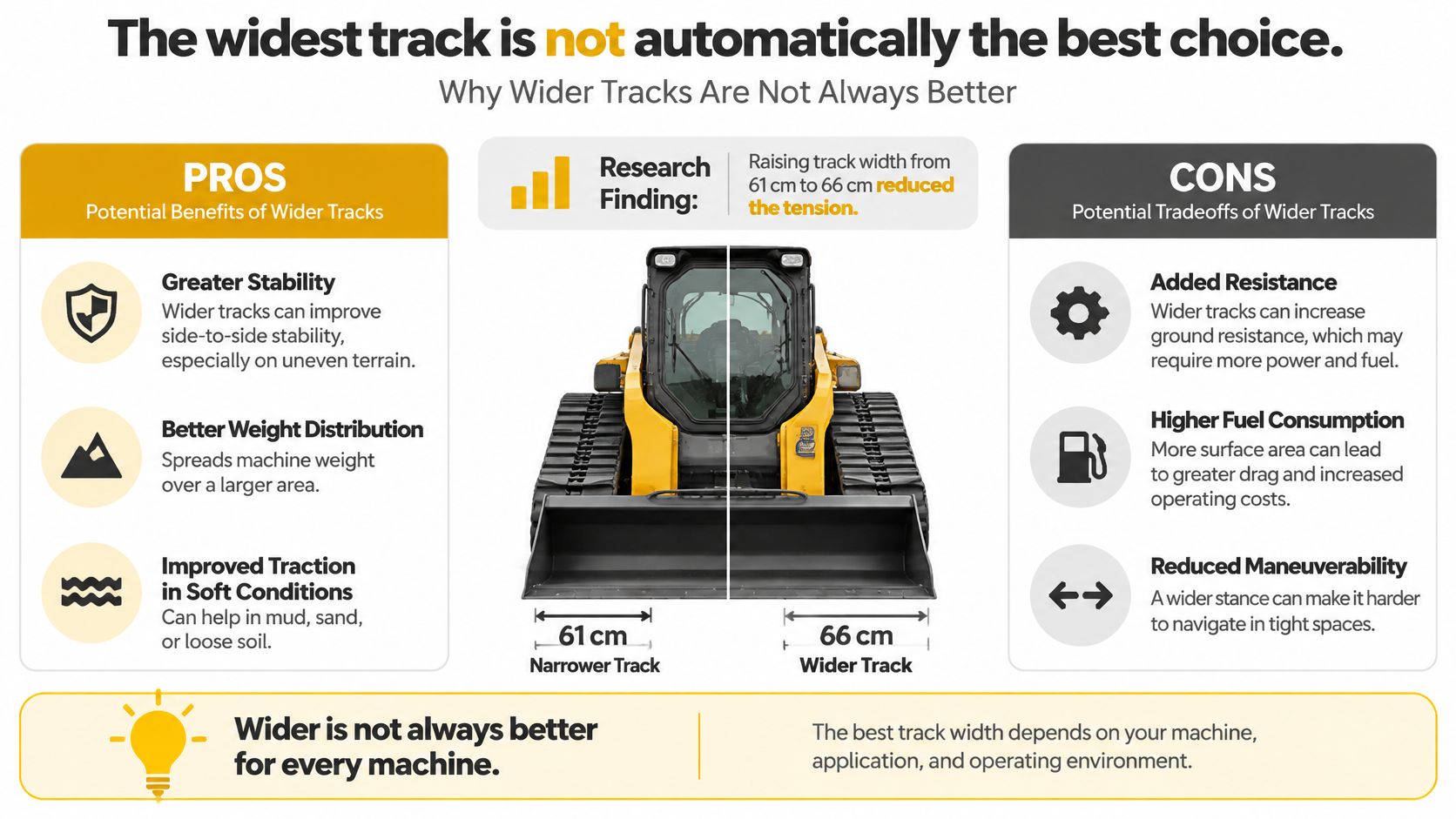
Research summarized in the USDA Forest Service paper on sliding stability of cable-assisted tracked logging equipment found that increasing track width from 61 cm to 66 cm reduced the tension required for sliding stability by only about 2 to 3%, with even smaller benefits on steeper slopes. Separate laboratory work described there found ground pressure and sinkage rise as vehicle weight increases, while rubber tracks distribute load and can reduce excessive sinkage, with track width and contact length acting as variables.
So wider tracks do spread load. On soft ground, that extra contact can improve flotation and cut rutting. The penalty shows up elsewhere, in gates, between buildings, and in the extra ground you tear up during turns.
| Situation | Narrower Tracks | Wider Tracks | Check First |
|---|---|---|---|
| Tight gates or narrow yards | Better access and turning | Harder to get through | Overall width against the gate |
| Soft or wet ground where rutting matters | Higher ground pressure | Better flotation and load spread | Ground pressure and undercarriage rating |
| Steep slopes | Less stability margin | Modest stability gain | Expected benefit at your slope angle |
| Road transport on a trailer | Keeps overall width lower | Adds width and permit concerns | Overall width, not track width |
| Mixed sites with several conditions | Favors access | Favors flotation | Whichever constraint appears most often |
Choose by the Constraint You Hit Most
Pick narrower tracks when access controls your day. If you're squeezing through residential gates, working between structures, or trailering often, a modest stability gain won't repay lost clearance. Performance choices shift with conditions too, which is why seasonal work such as skid steer tracks for snow needs its own check rather than a default wide pick.
Pick wider tracks when flotation controls your day. Wet yards, soft fields, and finished surfaces that can't take deep ruts reward load spread. Either way, confirm your undercarriage is designed for that width before fitting it, because a belt the machine wasn't built for is a problem no amount of flotation fixes.
Misconceptions and the Pre-Order Check
Four misconceptions cause most wrong orders. Each sounds reasonable, each feels like a shortcut, and each fails for a specific reason.
Four Claims to Retire
- Same brand, similar width, so it'll fit: Width alone can't confirm fit. Pitch, link count, sprockets, guide lugs, and the exact model or serial variant all have to line up, and a similar width guarantees none of them.
- Track width equals overall machine width: It doesn't. Gauge runs center to center, and the tracks themselves, plus attachments and body panels, extend beyond those centers on both sides.
- One model always uses one width: Many machines were built with more than one track width, and track widths aren't interchangeable without matching undercarriage parts. Your model's name alone doesn't settle which version you own.
- Outside-edge tape reading is close enough: It produces a neat number that's wider than gauge and different from belt width. Close enough is exactly how a plausible figure turns into freight you have to send back.
That last point matters for brand-specific shopping too. Whether you're checking sizes against listings for John Deere skid steer tracks or any other make, the measurement method stays the same, and the code on your current belt outranks any guess taken from the outside edges.
Your Pre-Order Check
- Confirm identity: Write down the make, model, and serial number. The serial number separates variants that share a model name but not an undercarriage.
- Record your three widths: Note track gauge, belt width, and overall width, each labeled. A supplier can work with labeled numbers and can't rescue unlabeled ones.
- Compare the molded size: Read the three numbers on the current track and set them against the spec sheet. Check that width, pitch, and link count all agree.
- Check clearance against overall width: Measure your tightest gate and your trailer deck, then compare both to the overall figure. Don't run this check against gauge.
- Get fit confirmed before shipment: Send the complete set of numbers and ask for confirmation. For Cat tracks, you find your machine model and track size, then send us your serial number so we can confirm fitment before the order ships, and a real person helps you find the right track fit before you order.
Write the three numbers down before you start shopping. A confirmed set of measurements prevents most ordering mistakes.
That habit is the whole system in one line. Gauge for the machine, belt width and the three-number code for the part, overall width for clearance. Keep them separate, keep them labeled, and What is track width stops being a confusing spec and becomes a measurement you trust.
When you're ready to order, send us your labeled measurements and serial number and we'll confirm the fit before anything leaves the shop. We stock replacement rubber tracks sold as pairs for compact track loaders, tracked skid steers, and mini excavators, and you can start your search at DirtPusher today.